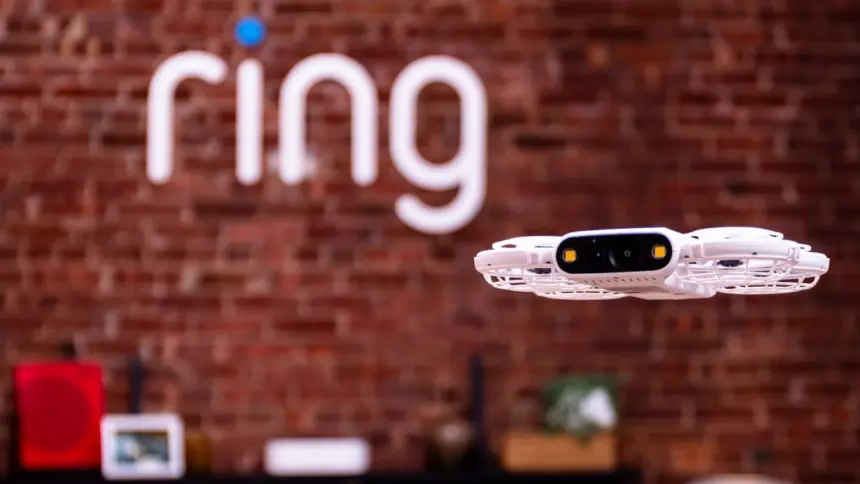
Amazon’s smart home subsidiary Ring has officially launched the Ring Drone Cam, a $249.99 flying indoor camera, alongside a $999.99 wheeled commercial robot named the Rover Cam. Unveiled on Tuesday under a new hardware division called Ring Robotics, the devices represent the retailer’s first commercial push into autonomous, mobile security patrols.
The flying camera weighs 165 grams and carries a 2K front-facing lens with a 148-degree field of view, paired with a downward camera and twin LED spotlights. It leaves its charging dock automatically when motion sensors, door contacts or alarms trip, flying between rooms or upstairs before returning to recharge.
Flight times run between five and eight minutes per charge, according to reporting by Mashable. Ring said eight minutes on the dock restores one minute of flight, with a complete recharge requiring about an hour.
Chief inventor Jamie Siminoff said the drone took a decade to arrive after work began in 2016, two years before Amazon acquired Ring. The company previewed an earlier model in 2020 but cancelled plans to ship a 2025 revision after finding edge-case fixes added sensors that demanded larger batteries and heavy shrouds, inflating estimated retail costs toward $5,000.
Ring resolved that cycle by moving flight processing off the aircraft and into Amazon’s cloud servers, as Wired reported. That switch kept the drone light, leaving it with only enough onboard logic to land safely if the local Wi-Fi drops.
Navigation and the AI Pilot platform
Both security machines steer using AI Pilot, a navigation platform combining optical sensors, custom vision models and cloud computing. The system integrates directly with Amazon’s Alexa Home Map, an interactive 3D floor plan released in October to plot household devices.

Owners do not fly the drone manually. Instead, users walk the aircraft through a property or let the software identify rooms, doors and windows. Once configured, tapping a destination on the phone app or triggering an alarm sends the drone on an automated flight path around obstacles and furniture.
The launch of AI Pilot also prompted questions around vocabulary. The White House recently issued an executive order telling federal departments to adopt the label super intelligence over artificial intelligence, according to TechRadar.
Asked whether Ring would change the software name, Siminoff declined: “Certainly we’re not trying to make any statements by how we’re using that.” Siminoff said the navigation system had been named long before the administration’s declaration.
Rover Cam takes over commercial floors
For industrial monitoring, Ring introduced the Rover Cam for $999.99, targeting warehouses, factories and commercial properties. Pre-orders opened on Tuesday, with deliveries beginning on 16 December 2026.
The ground unit repurposes chassis hardware from Amazon’s discontinued Astro robot, which first appeared in 2021 before an enterprise variant was dropped in 2024, as The Verge reported. Ring stripped Astro’s digital cartoon eyes and replaced domestic cupholders with a dedicated security tower.
The two-wheeled robot carries an extendable periscope camera that rises four feet to inspect shelving and countertops with 4K video. It includes two-way audio, a siren, flashing red lights, and an overhead projector that beams a blue ring onto ceilings to show its position across single-level sites up to 5,000 square feet.
Battery life on the Rover Cam lasts roughly 30 minutes between charges, allowing it to cover facilities on a single floor, The Verge reported. Unlike the flying camera, the rover continues monitoring for human movement even while resting on its charging dock, according to Engadget.
Privacy controls and loud hardware
The introduction of mobile indoor surveillance arrives alongside broader questions over domestic privacy. Ring has faced persistent scrutiny over past security practices, making data handling a central issue for its autonomous patrol machines.
Ring previously reached a settlement with the FTC over allegations that employees and contractors improperly accessed customer video feeds. The brand has also faced public pushback over its law enforcement sharing arrangements and automated facial recognition tools.
To ease domestic concerns, Ring made both machines noisy and visible. Demonstrations in New York showed the drone produces a loud, high-pitched buzz that Siminoff compared to an audible burglar deterrent, according to CNET. The noise also ensures anyone inside the property knows when a flight begins.
Amazon added that recorded footage is protected by TAKE technology, or Throw Away the Key Encryption. The method encrypts streams in transit, though Ring holds cloud keys momentarily to run cloud-based AI features before purging them.
Siminoff told CNBC the hardware offers an alternative to wall-mounted lenses: “People like indoor cameras, but they don’t necessarily want them everywhere around their home.”
While the Ring Rover Cam is available for pre-order now ahead of its 16 December 2026 release date, the $249.99 Ring Drone Cam is not yet open for pre-orders. Customers can currently sign up for email updates on Amazon before shipping begins on 27 January 2027.