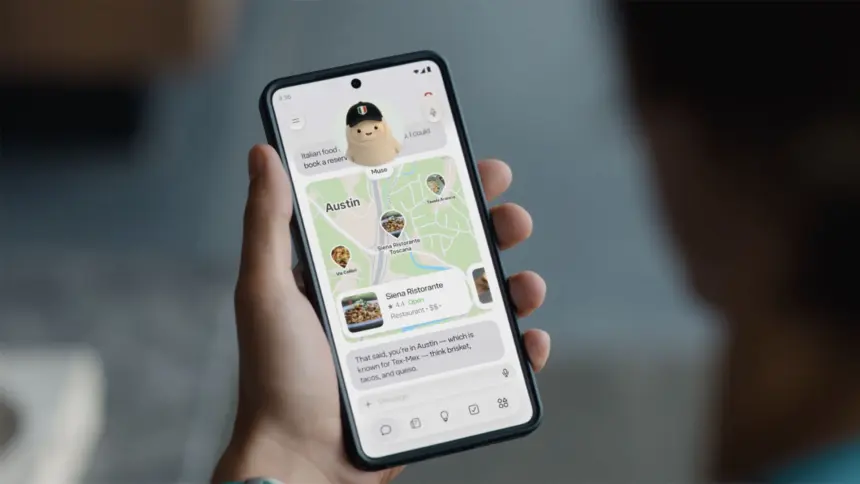
Meta Muse voice mode has launched in the United States alongside expressive visual avatars for the company’s AI assistant, enabling real-time spoken conversations across mobile, web and Mac applications. Announced on Thursday, the update allows users to talk directly to the agent, interrupt replies and select from hundreds of vocal styles.
Key points
- Muse users in the United States can hold real-time voice calls by tapping a phone icon inside the app.
- Expressive visual avatars sync lip movements and facial gestures to speech and react while listening to the user.
- Callers can choose from hundreds of voice styles, interrupt responses and switch between voice-only or full-screen displays.
- Meta confirmed that voice conversations will expand to Meta AI glasses and its upcoming Muse Charm hardware.
How do Muse voice mode and expressive avatars work?
To initiate a spoken conversation, users tap a phone icon situated in the top-right corner of the conversation screen within the Muse application. The interface starts a live call backed by two systems: Muse Realtime Voice for speech synthesis and Muse Realtime Avatar for rendering graphical reactions.
During a call, the avatar synchronises its lip movements and facial expressions with the generated audio. The animated character also shifts its expressions while listening to the user speak, creating interactive visual feedback rather than remaining static between replies.
Meta designed the system to support conversational interruptions. Callers do not need to wait for Muse to complete an answer before speaking, as the software cuts off its reply when the user talks over it.

Users who prefer not to display the character can alter the interface layout. Meta introduced three viewing options: a voice-only setting that hides the character entirely, a split-screen view placing the avatar next to the text chat, and a full-screen mode configured for a face-to-face visual call.
Voice customisation and rehearsal tools
The update includes hundreds of vocal options, letting users alter the assistant’s cadence and personality. In an announcement blog post, Meta highlighted personalities ranging from New York cadences to pirate accents, allowing users to swap styles whenever they choose.
Meta positioned spoken interaction as a practical tool for out-loud rehearsal. The company suggested users rehearse for job interviews, review presentation slides or talk through sales pitches, arguing that “some things are better rehearsed out loud” when testing material in real time.
Company executives highlighted the feature on social media during the launch. Alexandr Wang, Meta’s chief AI officer, published a video on X demonstrating a live session where he sought advice from his avatar, writing that users “can now phone call and video chat with your muse whenever you need.” Mark Zuckerberg, Meta’s chief executive, also posted on X to tease the release.

Deploying spoken conversational agents brings operational hurdles. When OpenAI introduced voice interaction for ChatGPT, online creator Husk went viral for his videos documenting repeated reasoning errors during spoken exchanges. Meta will face comparable scrutiny over whether Muse avoids similar mistakes during live voice sessions.
Rapid adoption and the Jolly mascot
The voice launch arrives roughly two months after Meta introduced Muse in September 2026. The standalone assistant accumulated more than five million downloads in that initial period, during which Meta released two updates under its Muse Wonder model family.
Central to Meta’s public branding for the software is Jolly, the character mascot representing the assistant. Mashable noted that adopting a friendly mascot reflects an industry trend toward anthropomorphising artificial intelligence, presenting software as approachable rather than intimidating.
The steady release of features reflects substantial capital expenditure by Meta on computing infrastructure. Those investments have enabled the company’s frontier models to reach performance levels comparable to top rival systems in consumer AI.
Hardware plans for smart glasses and Muse Charm
Availability of the real-time voice mode and expressive avatars is currently confined to users in the United States across the Muse mobile application, web browser interface and Mac client.
Meta plans to bring spoken interaction to wearable hardware. The company confirmed that voice calls with Muse will launch on Meta AI smart glasses as well as its upcoming Muse Charm device.