Amazon has assembled a specialised engineering unit to develop a new consumer machine, marking its latest push for an Amazon home robot, according to recruitment records reported by CNBC on 8 November 2026. The company is pairing Astro engineers with staff from newly acquired startup Fauna Robotics to design a device capable of operating autonomously alongside families.
A second attempt at domestic hardware
Over the past several months, Amazon structured the project inside a newly formed division called the Personal Robotics Group. The team draws staff from Lab126, the research organisation responsible for the Kindle e-reader and Echo smart speakers, as well as an MIT roboticist hired earlier this year.
The division is recruiting across interaction design, cloud telemetry and customer support, according to an analysis of job adverts published by Unite.AI. A since-removed engineering listing described a machine capable of autonomous navigation through changing domestic settings and functioning safely around household members.
A Principal UX Designer listing tasks recruits with defining how the robot communicates, builds trust with family members, and conveys body language during everyday interactions. The design brief runs from early concept work through to final production.
Infrastructure listings indicate Amazon is preparing for hardware deployments outside controlled environments. A field support engineer listing assigns a primary contact for remote hardware and software diagnostics, on-site repairs and root-cause resolution for machines placed in customer homes.
Integrating Fauna and the Sprout humanoid
The initiative gained momentum in March 2026 when Amazon purchased New York startup Fauna Robotics, as announced by Fauna. The firm now operates as an Amazon subsidiary within the Personal Robotics Group.

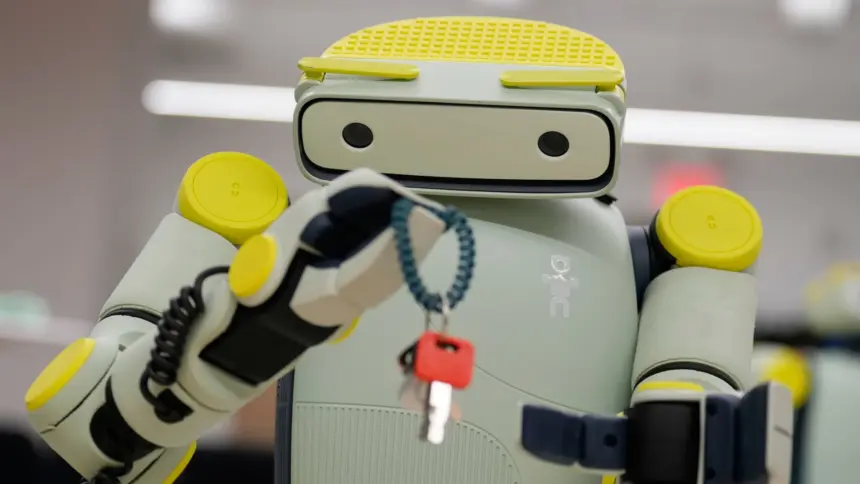
Fauna originally built Sprout, a bipedal humanoid standing 1.07 metres tall and weighing 22.7 kilograms. The machine features a soft exterior shell, motor controls that yield when meeting external resistance, time-of-flight sensors to track obstacles, and expressive yellow eyebrows.
Fauna introduced Sprout in January 2026 as a development kit for researchers, universities and commercial developers. The platform incorporates pre-trained motion controls for walking, kneeling, crawling and sitting, while allowing external artificial intelligence models to guide higher-level decisions.
Amazon spokesperson Brad Glasser said the company acquired Fauna to confront practical engineering challenges in domestic environments. Glasser said operating an autonomous machine in a living room requires resolving significant hurdles that do not arise inside controlled research laboratories.
Why Astro struggled to find buyers
Amazon founder Jeff Bezos first directed hardware executives to pursue household robotics in 2017. That project culminated in the launch of Astro in 2021, an invite-only wheeled screen priced at $1,450.
Astro could patrol rooms, map floor plans and recognise household members, but it struggled to find a clear purpose. Amazon shipped only a few thousand units to consumers, while a business variant introduced in 2023 was withdrawn less than a year later.
Early customers found Astro offered little utility beyond roving security checks. Emily Lugo Velez, an IT and artificial intelligence adviser in North Carolina who bought Astro in 2023, told CNBC the machine had become a party trick and a trip hazard that spends most days on its charger. In online owner forums, users have reported declining customer support and noted that Amazon’s newer Alexa+ assistant is not supported on the device.
Ken Washington, who served as Amazon’s vice-president of consumer robotics until 2023, told CNBC that internal discussions examined adding mechanical arms to grasp objects or shifting to bipedal movement, but leadership decided against legs.
Navigating a home presents complex physical barriers. Jeff Burnstein, president of the Association for Advancing Automation, pointed out that domestic settings differ drastically from warehouses because robots must manage children, pets, older relatives and stairways, with no two houses laid out identically.
Colin Angle, a co-founder and former chief executive of Roomba maker iRobot, told CNBC that when the Astro team began, their development tools were “clubs with nails in them, just incredibly primitive.”
The wider push into physical artificial intelligence
Consumer robotics has attracted fresh investment as machine learning models, actuators and sensor hardware improve. In his 2025 shareholder letter, Amazon chief executive Andy Jassy wrote that artificial intelligence and robotics were among the “biggest inflections of our lifetime.”
Amazon already manages more than one million warehouse robots across its global fulfilment centres following its 2012 purchase of Kiva Systems for $775 million. Jassy indicated the company intends to transfer those operational feedback loops into consumer hardware.
Private capital is backing that shift. Venture capital firms invested $33.4 billion in robotics and physical AI businesses in the first half of 2026, surpassing the $28.7 billion recorded for the whole of 2025, according to PitchBook.
Financial analysts expect domestic and personal robotics to expand significantly over the coming decade. An analysis published by Barclays estimates that the global market for humanoid machines could climb from around $3 billion today to $40 billion by 2035, and up to $200 billion under optimistic conditions.
Other technology companies are pursuing similar ambitions. Apple is investigating tabletop robotic concepts, Tesla continues work on its bipedal Optimus robot, and startups including Sunday, Tau and Nori are testing prototypes designed to assist with household chores like folding laundry and clearing tables.
Amazon has not announced a launch window, form factor or price for its next consumer machine. The recruitment drive establishes an active research and development programme rather than an imminent product release, leaving open the question of what everyday domestic tasks the hardware will ultimately handle.