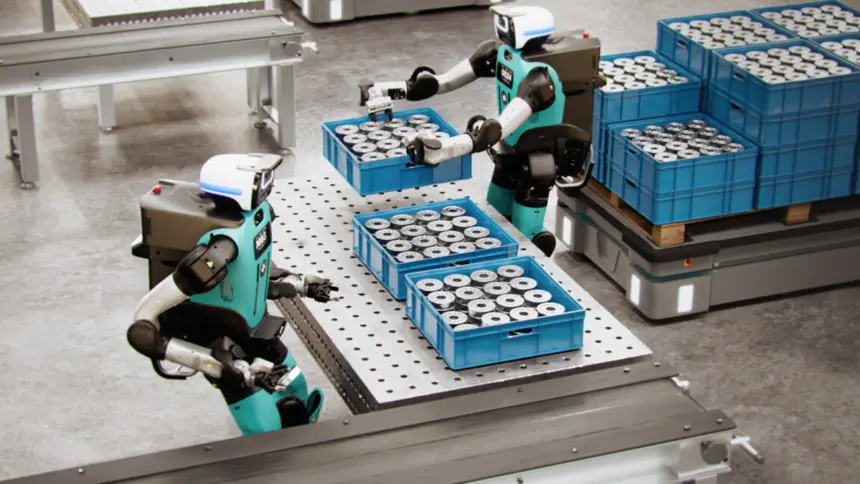
Agility Robotics began trading on the Nasdaq stock exchange on 5 November 2026, raising $465 million to become the first publicly traded dedicated humanoid robot maker in the United States. Trading under the ticker AGLT, the Agility Robotics Nasdaq debut aims to fund the commercial rollout of its bipedal warehouse machines.
Key points
- Agility Robotics raised $465 million before expenses by completing a reverse merger with special purpose acquisition company Churchill Capital Corp. XI.
- The company disclosed deep operational losses, generating $174,000 in revenue against a $362 million net loss during the first six months of 2026.
- Agility cited $300 million in customer commitments for its upcoming Digit 5 robot, though executive statements and regulatory filings diverge on the structure of those deals.
Capital raised and financial losses
Agility completed its public listing through a merger with a special purpose acquisition company, joining with Churchill Capital Corp. XI. The transaction supplied roughly $465 million in capital before expenses, including a roughly $201 million private placement led by Foxconn, alongside backing from Nvidia.
The listing establishes Agility as the first dedicated humanoid robotics developer to trade publicly in the United States. Globally, the debut follows Chinese competitor Unitree, which listed its shares on the Shanghai Stock Exchange STAR Market in August 2026.
Going public exposes Agility’s balance sheet to outside scrutiny. US regulatory papers, specifically an S-4 registration statement submitted in September, show the company generated $1.8 million in revenue during 2025 against an operating loss of $140 million.

Financial pressures expanded during 2026. Agility booked $174,000 in revenue in the first half of the year, mostly from related parties, while recording $362 million in net losses.
Despite the cash burn, the market arrival refutes earlier predictions from rivals. Colby Adcock, chief executive of competitor Figure AI, had forecast in late 2025 that Agility would be bankrupt within twelve months. Peggy Johnson, Agility’s chief executive, said the capital raised will cover current operational demands, though she declined to confirm whether the funds would make the business permanently self-sustaining.
How does Agility’s robot subscription model work?
Agility intends to generate recurring revenue through robots as a service. Under this subscription structure, customers pay an initial deployment fee of $25,000 per machine, alongside an ongoing fee of $8,500 each month for software and field maintenance.
Corporate clients can also buy machines outright for $200,000, plus a $20,000 installation cost. Purchased units still require an ongoing software and maintenance contract costing $36,000 annually, or about $3,000 per month.

Michael Beer, Agility’s chief financial officer, outlined the economic rationale during a presentation for analysts and investors in October. Beer said renting a robot replaces roughly $200,000 in annual human labour costs with $100,000 in robot expenses. An outright purchase replaces about $1.1 million in human wages over five years for approximately $400,000 in total robot hardware and maintenance costs.
Manufacturing costs remain high at early production volumes. Agility estimated that the initial bill of materials for each Digit 5 robot stands at $150,000. The company projects that expense will drop to $75,000 per unit once production hits 1,000 robots annually, and $30,000 if annual assembly reaches 10,000 units at its RoboFab plant in Oregon.
Where are Digit robots deployed and how does Digit 5 work?
Unlike competitors that highlight backflips and choreography on social media, Agility has concentrated on shifting physical totes in industrial workplaces. “You don’t see a lot of dancing robots or backflipping robots from Agility,” Johnson said.
Agility spun out of Oregon State University in 2015 after researchers developed bipedal walking systems. The firm has since gathered 65,000 hours of operational data from commercial client sites, using real-world movement logs to train robot control systems alongside computer simulations.
Nine commercial clients currently run earlier iterations of Digit. Deployments include the warehouses of logistics company GXO, where robots have moved more than 100,000 totes across a facility in Georgia. GXO plans to expand the machines to sites in North Carolina and Tennessee. Other active customers include German automotive manufacturer Schaeffler at its South Carolina factory, Mercado Libre, and Toyota Motor Manufacturing Canada.
Field operations will transition to the latest Agility robot known as Digit 5. The machine carries loads up to 50 pounds, features swappable end-effector hands, and can work for more than 20 hours in every 24-hour cycle.
Fast charging enables that working schedule. Battery packs provided by the UK-based company Nyobolt fully recharge in nine minutes to deliver 90 minutes of active movement. Unlike prior machines confined to isolated cages, Digit 5 includes sensors that cause it to stop or crouch when staff walk near, allowing it to share open aisles with human workers.
Commercial orders and customer commitments
Disclosures about Agility’s commercial order pipeline present differing details. Chief executive Peggy Johnson reported that the company has secured $300 million in planned contracts across 30 customers for Digit 5. However, Agility’s SEC S-4 filing based its $300 million subscription revenue model on an order for 1,000 robots across a three-year contract with a single, unidentified customer.
These commercial commitments do not represent guaranteed income. The agreements require Agility to meet specific operational milestones, product features, and performance metrics, including throughput, uptime, and placement precision. Prospective customers must spend $500,000 for Agility to conduct an on-site proof of concept before full deployment, with four customers signed up for these pilot trials as of May 2026.
While the current robot places totes with 98 per cent accuracy, it cannot yet carry out complex, dexterous manipulation tasks. Jonathan Hurst, co-founder and chief robot officer, said Agility’s immediate focus remains moving containers, totes, and packages before tackling complex loading tasks across logistics networks.
Agility plans to demonstrate working Digit 5 prototypes at the CES 2027 trade show. Full commercial shipments to customer warehouses are scheduled to begin at the end of that year.