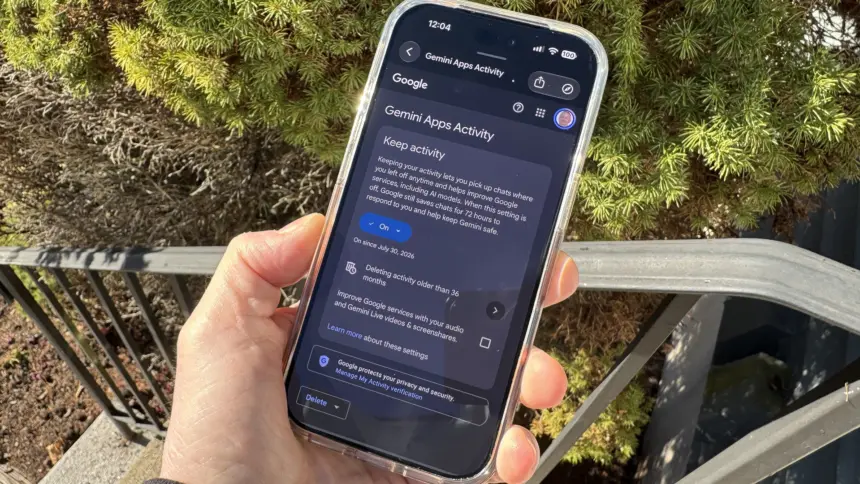
Google is extending Gemini chat retention from 72 hours to around two months for temporary chats and users with history turned off, in a global Gemini app update reported on 17 November 2026. At the same time, Google is separating chat history and AI model training controls so users can opt out without losing past conversations.
The change increases Google’s retention window for temporary chats and history-off sessions twentyfold, The Register reported. According to TechCrunch, an archived 12 November version of Google’s support documentation listed a 72-hour limit for temporary conversations and chats started with history disabled.
Two-month retention for Gemini temporary and history-off chats
Google said in a company blog post that keeping Gemini temporary chats and conversations made with chat history turned off for around two months helps improve safety and security as AI systems become more capable. The company said the longer window lets it respond to users, process feedback, and protect its services and users.
Temporary conversations are excluded from AI model training, according to Google’s updated Gemini Apps Privacy Hub, which also mentions potential system failures as a reason for keeping the records. Google did not answer TechCrunch’s questions about what triggered the change or whether it alters how conversations are accessed or reviewed.
How do you opt out of Gemini AI model training?
Until now, a single toggle called Keep Activity governed both chat history and Gemini AI model training, ZDNet reported. Users who wanted to stop Google from training on their prompts or uploaded files had to disable chat history altogether, which blocked them from returning to earlier conversations.
Google is replacing Keep Activity with two independent toggles. One setting lets users keep or delete past conversations and pick how long history is stored, while the second controls whether chats, including text and attachments, feed into generative AI training.

“With this change, you will be able to keep your history while independently controlling generative AI model training,” Google said in an email sent to Gemini users. Ars Technica reported that the training toggle sits under Activity in Gemini settings, or under Data and Privacy, My Activity, Other activity, and Gemini Apps Activity inside a Google account.
What happens to past Gemini chats and settings?
Defaults under the new layout depend on a user’s earlier choice. Google said both new settings will be switched off by default for people who previously disabled Keep Activity, whereas people who left it on will keep their chat history enabled and must opt out of Gemini training separately.
The opt-out applies only to future chats. Ars Technica reported that data previously sent to Gemini, including prompts, responses, uploaded files, tool calls, location information, and material from connected apps, has already entered Google’s training pool.
Google tries to strip personal details from Gemini activity history, though this is not guaranteed, and the company can keep that training material for as long as three years, Ars Technica reported.
How Gemini compares with ChatGPT and Claude
Google’s two-month window for temporary chats is roughly twice as long as its main rivals. OpenAI’s ChatGPT temporary chat documentation says those sessions may be kept for up to 30 days, and Anthropic’s Claude incognito chat support page lists a 30-day default, with both firms reserving longer retention for legal, safety, or policy reviews.
On model training controls, ZDNet reported that Google had been the only major AI provider tying training opt-outs to the loss of chat history. ChatGPT users can disable a setting called “Improve the model for everyone”, Microsoft Copilot offers separate toggles for conversation and voice training, and Claude disables model training by default while keeping user history intact.
Ars Technica reported that the split controls are currently rolling out, while TechCrunch and ZDNet reported that the global Gemini app update will roll out over the coming weeks.