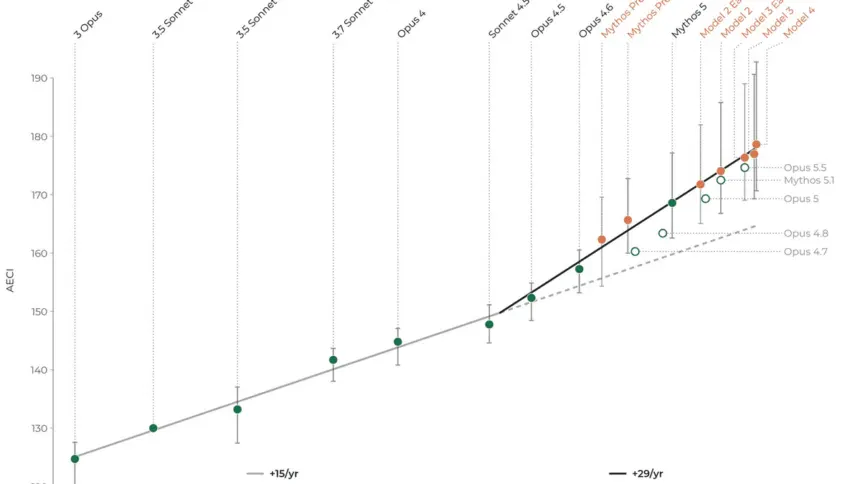
Anthropic capability growth has doubled over the past year as internal AI tools accelerated research, according to an independent evaluation published on Thursday, 5 November 2026, by safety group METR. The San Francisco developer matched two years of previous benchmark progress in just twelve months.
Key points
- Independent evaluator METR found Anthropic improved benchmark scores 1.9 times faster over the past twelve months.
- AI tools assisting researchers drove most of the speedup, while an expansion in training compute was ruled out.
- Evaluators identified no technical bottlenecks in computing power, algorithms or data likely to restrict progress over the next year.
- The findings carry added weight because the US government encourages AI companies to police their own safety ahead of Anthropic’s share listing.
Benchmark evidence shows faster development
Model Evaluation and Threat Research, a Berkeley-based non-profit organisation known as METR, published an independent assessment examining Anthropic’s research pace. The team analysed the company’s internal benchmark capability index, known as AECI, tracking results between October 2025 and October 2026.
Anthropic advanced across internal benchmarks at roughly 1.9 times its earlier pace during that twelve-month window. METR calculated a 95 per cent confidence interval of 1.5 to 2.8 times the historical rate. Under alternative modelling choices regarding task difficulty, the acceleration estimates ranged from 1.1 to 2.9 times.
The assessment compared progress against a baseline observed from March 2024 through October 2025. In its report, the evaluation group said “Anthropic appears to have made as much progress on benchmarks in the past year as they did between October 2023 and October 2025.”

The dataset included unreleased internal systems alongside public models. Evaluators dated each snapshot from the day most Anthropic employees could access it, establishing a consistent timeline across all software versions.
How AI tools speed up research
METR investigated the drivers behind the speedup and concluded that growth in training computing power did not cause the acceleration. Non-AI factors assisted work in late 2025, but evaluators judged that AI tools assisting human staff account for the sustained momentum.
Anthropic confirmed that its Claude chatbot increasingly assists engineers in building more capable models. In informal internal polls, technical staff reported an average twelvefold productivity gain when using the most capable internal model in October 2026. METR cautioned that these casual responses required little effort and do not reflect company-wide progress.
Interviews with roughly 15 key technical staff yielded uneven findings, with reported productivity gains that varied widely around an approximately twofold acceleration. Evaluators determined that AI cannot yet make autonomous contributions to core model training, although researchers described indications that independent contributions could emerge soon.

Technical bottlenecks and redacted findings
The assessment examined whether technical constraints would halt the current pace. METR found no convincing evidence that training compute, experimental hardware, data supplies or algorithmic discoveries would impose significant bottlenecks over the next twelve months.
The reviewers expressed caution about that judgment. Their internal views shifted several times throughout the eleven-week study, leaving them uncertain about future constraints. Without clear bottlenecks or steep diminishing returns, METR warned that compounding gains could produce even faster acceleration.
Measurement limits also complicated the assessment. The AECI benchmark focuses on well-specified, automated tasks that may not reflect messy real-world challenges. Anthropic’s Model 4 also scored above 50 per cent across all 15 benchmark tests, raising concerns that test saturation could hinder future measurement.
METR staffed the study with 2.5 full-time equivalents between 12 August and 29 October 2026 without accepting payment. Anthropic retained the right to redact material and removed a majority of the most informative evidence, including detailed AI attribution and future model forecasts, citing commercial secrecy.
What does the speedup mean for Anthropic?
The rapid acceleration arrives as Anthropic prepares for an initial public offering of stock on Wall Street later this month. Analysts expect the listing could become the largest stock debut in history.
The findings carry added significance because information about model performance and system risks has come almost exclusively from the technology firms themselves. The administration of President Donald Trump has encouraged artificial intelligence companies to police themselves on safety matters, leaving outside scrutiny largely to independent groups.
The speedup also contrasts with public warnings from Anthropic leadership. In a September essay on runaway technology, chief executive Dario Amodei called on the industry to “slow the pace at which we improve the capabilities of AI models” so safety safeguards can catch up.
Amodei warned that recursive self-improvement, where AI systems build the next generation of software, could outrun human control if left unchecked. He advocated embedding external evaluators inside frontier laboratories to monitor progress. OpenAI chief executive Sam Altman expressed support for that proposal.
Anthropic did not respond to requests for comment regarding the report.