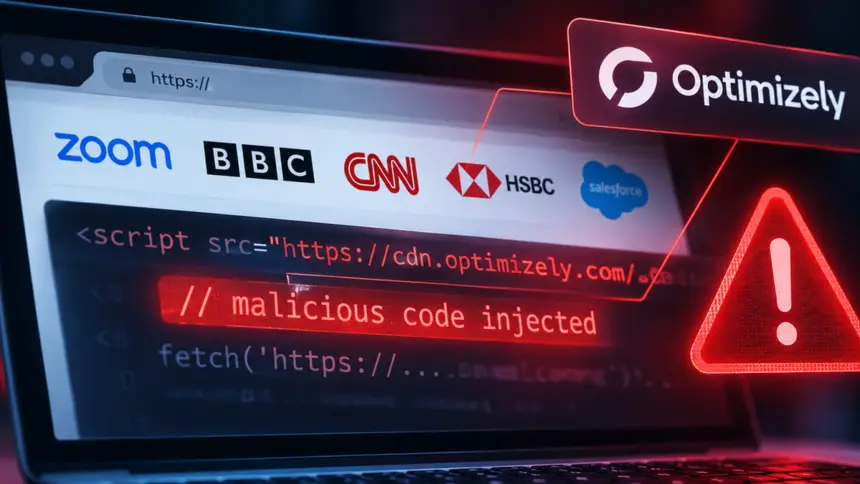
An Optimizely supply chain attack on 16 November 2026 injected malicious JavaScript into 188 code snippets across 178 organisations, including Zoom, the BBC, CNN, Salesforce, GitLab, HSBC and Equifax. The script hijacked cryptocurrency wallet addresses, skimmed payment card details, captured cookies and screenshots, and targeted iPhones and iPads with exploit kits.
Security researcher Scott Helme and his firm Report URI uncovered the breach after scanning 1,611 distinct Optimizely Web files. Optimizely told BleepingComputer that an attacker exploited a flaw in its Experimentation account signup flow to insert unauthorised code into customer projects.
Most of the malicious code had been removed by late Monday evening, though investigators have not established how many visitors were exposed or how much data was taken. By 19:25 UTC on 16 November, cryptocurrency wallets linked to the campaign had received about $7,040 over roughly nine hours, Report URI said.
How the Optimizely hack worked
Optimizely Web lets companies test and personalise websites by loading a JavaScript snippet from Optimizely’s content delivery network or a customer-hosted domain. Each snippet includes a custom Project JavaScript field where clients can add code that runs on every page.
Attackers wrote malicious code directly into that Project JavaScript field, leaving the rest of each customer file untouched, Report URI found. Because the modified files still came from Optimizely’s servers with valid certificates, affected websites loaded the payload from a source they already trusted. Optimizely’s own main website and login page were also affected.
Optimizely spokesperson Victoria Johnson told Gizmodo an unauthorised party “exploited a vulnerability in the Experimentation account signup flow”. Report URI noted that Smartsheet’s file was cleaned and then re-infected during the day, indicating the intruder retained write access while cleanup began.

The injected code used three loading methods. Most snippets inserted a script tag pointing to a remote file named track.js at 1688360.cc. Other versions hid the address using Base64 encoding or embedded an inline copy to run through eval if the external domain was blocked.
Report URI’s crawl found affected organisations across 20 sectors, led by 32 in banking and finance, 23 in technology and software, and 20 in retail. Beyond Zoom and the BBC, the list included Fox News, IKEA, Air France-KLM, Peacock, Ledger, Bitly, Stamps.com, Change.org, UNICEF USA, NPR and Vodafone Australia.
What the malicious script stole
Report URI observed 26 rebuilds of the track.js payload during 16 November as the attackers added new features and cryptocurrency addresses. Every visitor received the same script, with its behaviour depending on the user’s device and actions on the page.
Analysis by Report URI and BleepingComputer showed the payload carried four main functions:
- Cryptocurrency hijacking: The script scanned page text, forms, links, images, the browser clipboard and the iOS share sheet for valid wallet addresses across nine networks, including Bitcoin, Ethereum, TRON and Solana, swapping them for attacker addresses.
- Payment card skimming: Added at 13:43 UTC, this module watched form submissions and POST requests for card numbers, expiry dates and security codes, sending them to 1688360.cc. Cards typed into third-party payment frames from providers such as Stripe or Adyen stayed out of reach.
- Cookie and screenshot theft: When replacing an address near payment wording, the script transmitted the webpage address, non-HttpOnly cookies, the original wallet address and a rendered page screenshot to the attackers.
- iOS exploit kits: On iPhones and iPads, the script fetched another loader that checked the operating system version and served the Coruna or DarkSword exploit kits inside a hidden frame.
Report URI said the Coruna loader matched a sample from a separate October campaign byte-for-byte. Comments inside the kit indicated that Apple’s iOS 18.7.3 and iOS 26.3 updates patched the targeted flaws, while devices on iOS 18.6 or earlier reloaded infected pages every 60 seconds to retry the exploit.
Tracking the stolen funds remains difficult. Funds were swept from the attackers’ wallets between 13:03 and 13:05 UTC, with USDC on Ethereum moving to a HitBTC deposit address. Report URI noted the TRON wallet had been active since March 2026, meaning not all of the roughly $7,040 came from this campaign.
Why website security policies missed it
Report URI checked the Content Security Policy headers on 256 hostnames belonging to affected organisations and found only 24 blocked the attack completely. Allowing Optimizely’s domain did not protect sites because the malicious code arrived inside Optimizely’s own trusted files.
At 17 sites, rules restricting outbound connections blocked stolen card numbers, cookies and screenshots from leaving the browser, though in-page wallet swapping still worked. Two common settings, strict-dynamic and unsafe-eval, let the malware run. Optimizely’s documentation tells customers to allow unsafe-eval, which allowed the inline fallback to execute on HSBC’s site even after its policy blocked track.js.
Cybersecurity firm HudsonRock also reported finding evidence that affected sites served malicious code to visitors, according to Economic Times Tech, citing Reuters. Reuters could not confirm whether the scripts succeeded in every case or the scale of any resulting breaches.
Cleanup and advice for visitors
Optimizely said it blocked the vulnerable signup path, deployed a fix, scrubbed the injected code, ended active sessions, revoked tokens, reset affected user accounts and blocked code delivery through Cloudflare. By 21:52 UTC on 16 November, only TalkTalk’s snippet among the 188 infected files still carried the payload, down from 169 less than an hour earlier.
Several targeted companies took extra precautions. Salesforce said it disabled Optimizely scripts across preview and production environments while investigating. Equifax said it stopped using Optimizely and found no sign of a breach on its own systems.
Security researchers advised anyone who visited an affected website on 16 November to check cryptocurrency transactions for swapped destination addresses, monitor payment card statements for unauthorised charges and watch logged-in accounts for unusual activity. People with iPhones or iPads should install the latest Apple software updates, making sure their devices are running at least version 18.7.3 or 26.3.
Report URI advised Optimizely Web customers to inspect their Project JavaScript and experiment code for unexpected scripts, rotate API tokens and credentials, treat exposed card forms and non-HttpOnly cookies as compromised, and tighten Content Security Policy headers. Optimizely said it is continuing to investigate and will post updates on its status page.