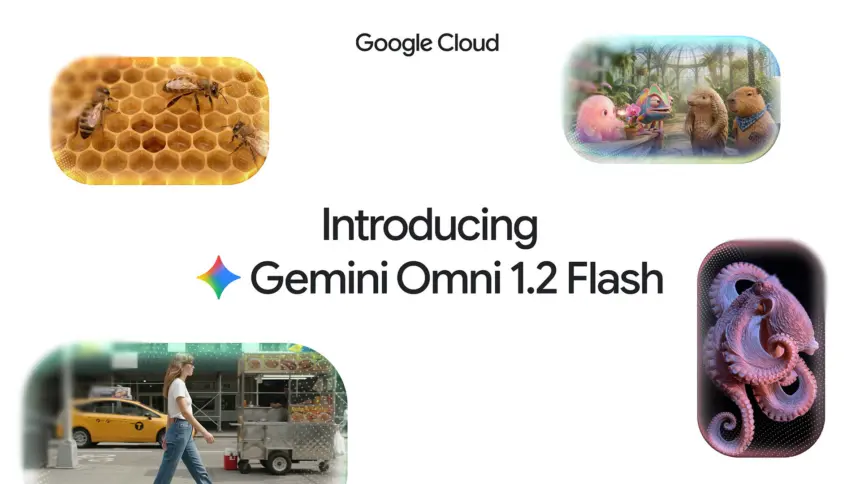
Google launched Gemini Omni 1.2 Flash to general availability on Thursday, 5 November 2026, extending native video generation to 15 seconds and cutting prices by 30 per cent. The updated model produces synchronised video and audio from text, images and video, adding multi-turn conversational editing through Google Cloud and the developer API.
Key points
- Native video clip generation now supports durations between three and 15 seconds at 720p.
- Output pricing falls by 30 per cent to roughly $0.07 per second on the paid developer API.
- Conversational editing allows targeted revisions to backgrounds, lighting and camera angles across multiple turns.
- Existing Gemini Omni 1.1 integrations will automatically route to version 1.2 on 3 December 2026.
How do 15-second clips and conversational editing work in Gemini Omni 1.2 Flash?
According to Google’s developer documentation, Gemini Omni 1.2 Flash supports whole-second output durations from three to 15 seconds. The prior model, Omni 1.1, had a ceiling of 10 seconds. The system defaults to 10 seconds, rendering at 720p resolution in a 16:9 landscape format, with 9:16 portrait also available.
The model generates synchronised video and native audio directly from text descriptions, reference images and existing video clips. Google designed the 15-second duration to fit full narrative sequences, product demonstrations and social advertisements within a single generation run.
Developers can adopt a tiered workflow to manage rendering expenses. Teams can draft scenes at 360p or 720p, correct specific details, and then upscale approved footage to 1080p or 4K resolution.
A core addition is conversational editing, which allows users to alter an existing clip across iterative turns. Teams can swap out backgrounds, replace featured products, adjust lighting conditions, change weather effects or reformat aspect ratios without modifying unaffected elements in the frame.
To support multi-turn workflows, the API assigns a previous-interaction identifier to requests. This token preserves context between calls, removing the requirement to re-upload the earlier video file. Prompts can incorporate as many as six reference images, including up to three reference photos per character for up to two distinct characters.
Video extension remains a separate mechanism from native generation. Developers can append between three and 10 seconds per API turn, drawing on the final 10 seconds of the clip as context, up to a maximum total length of 30 seconds.
The tool cannot prepend video or insert clips into the middle of existing footage. Interpolation between first and last frames also remains limited to clips between three and 10 seconds long.

What does Gemini Omni 1.2 Flash cost and when is the Omni 1.1 migration?
Google reduced the cost of 720p video generation by 30 per cent compared with Omni 1.1. On the paid Gemini API, video output costs $12 per million tokens, detailed in the updated pricing table.
Google meters 720p video at 5,792 tokens per second, which works out to approximately $0.07 per second. A 10-second clip costs roughly $0.70, while a full 15-second clip costs approximately $1.04. Text, image and video inputs cost $1.50 per million tokens, and the model is excluded from Google’s free tier.
The company established a four-week transition window for current users. Gemini Omni 1.1 Flash remains active until 3 December 2026. On that date, API calls pointing to version 1.1 will automatically redirect to Gemini Omni 1.2 Flash without requiring code changes, switching directly to the lower pricing structure.
Consistency benchmarks and technical limits
Generative video systems frequently suffer from visual drift, where characters or objects warp across camera movements. In its Gemini Omni 1.2 Flash announcement, Google said the updated architecture improves identity preservation for human faces, garments, brand colours and packaging typography across shifting camera angles.
To demonstrate reference adherence, Google presented a virtual try-on demonstration. Using a single portrait of a model alongside product images of three outfits, Gemini Omni 1.2 Flash produced a 15-second sequence featuring 360-degree turns while preserving the model’s appearance and the cut and drape of each garment.
In side-by-side evaluations conducted by Google DeepMind, Omni 1.2 achieved a 62 per cent win rate over Omni 1.1 for visual consistency in text-to-video tests. In multi-reference evaluations, where the model must preserve identity from provided images, version 1.2 secured a 63 per cent win rate against 37 per cent for its predecessor.
Google also reported improvements in audio and camera control. The model produces clearer lip-sync, handles dialogue conditioning for multiple speakers, and follows continuous camera movements such as first-person drone paths and dramatic zooms with fewer unwanted jump cuts.
Several technical constraints remain. Google noted that the system still struggles with fast sports action, rapid script changes and complex physical interactions. The Gemini API supports English prompts, but Google has not evaluated performance in other languages.
Voice editing, direct audio uploads and audio reference inputs are unsupported in the standard API. Every clip generated through the API embeds an invisible SynthID watermark for machine-readable provenance checks.
Enterprise availability across Google products
The release is deploying across consumer, advertising and enterprise channels. Developers can test prompts in Google AI Studio or connect directly to the paid API.
In Google’s creative tools, the model powers Flow for scene direction and iterative video adjustments. Workspace users and Google account holders can generate longer clips in Google Vids at no additional charge. Google Ads incorporates the model for automated campaign generation, while Google AI Ultra subscribers gain access through the consumer Gemini application.
For corporate infrastructure, the general-availability announcement from Google Cloud added console deployment, enterprise security guarantees and Provisioned Throughput options. Audio reference inputs are available on Google Cloud, but access is restricted behind an allowlist.
Commercial developers have started putting the model into production. Matt Rouif, chief executive of image-editing platform Photoroom, said longer clip limits had been the most requested feature from his users. Rouif said formal service-level agreements on Google Cloud allow Photoroom to run Gemini Omni Flash in production tools such as its Video Ad Maker and Product Animator.
Google Cloud and developer API access are open immediately, with automatic migration for legacy integrations concluding on 3 December 2026.