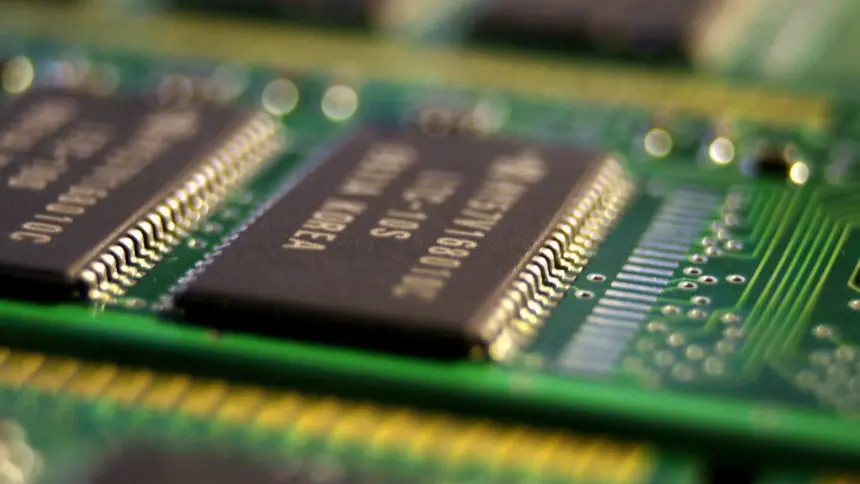
OpenAI chief executive Sam Altman triggered sharp criticism from computer builders and developers this week after arguing that consumer PC RAM should be pooled into cloud data centres instead of sitting on personal desks, as artificial intelligence infrastructure continues to drain the global semiconductor supply chain.
Key points
- Altman told the Cheeky Pint podcast that dedicating dynamic random-access memory to desktop computers during a global chip shortage was an inefficient allocation of resources.
- The OpenAI executive argued that personal computers leave memory idle most of the day, whereas centralised cloud clusters maintain continuous workloads.
- Long-term memory supply agreements for enterprise clusters, including OpenAI’s Stargate project, have driven up component prices for consumer laptops and developer workstations.
- Software engineers and privacy advocates warned that centralising memory in remote facilities restricts independent research and weakens local open-source development.
Cloud utilisation versus desktop hardware
Altman addressed the strained global memory supply during an appearance on Stripe co-founder John Collison’s podcast, Cheeky Pint. Speaking in a pub booth over drinks, the discussion moved from technical advances in artificial intelligence to the physical infrastructure required to operate large computational clusters.
Addressing the growing movement among programmers to run open models on desktop workstations, Altman rejected the premise that personal hardware solves the sector’s compute limits. Instead, he maintained that spreading high-capacity memory sticks across millions of private workstations leaves silicon idle.
Altman said it was “quite terrible to have everybody have a bunch of the world’s limited supply of DRAM sitting in their own computer” while running tasks only five per cent of the day. He contended that central cloud systems solve that waste by keeping hardware engaged around the clock.

“You want maximum utilization in the cloud if you’re trying to deal with this very supply constrained environment,” Altman said on the programme. He added that the widespread instinct among engineers to secure dedicated memory on their own desks ran contrary to effective global allocation.
How data centres squeezed global memory supply
Altman’s comments arrived as retail buyers face rising prices across the semiconductor trade. Over the past year, dynamic random-access memory and solid-state storage have grown substantially more expensive for consumer builds, gaming rigs and professional developer setups.
Hyperscale cloud providers and artificial intelligence laboratories have spent tens of billions of dollars securing multi-year output agreements with major memory manufacturers. Suppliers such as Samsung and SK Hynix have committed large shares of their advanced production lines to corporate data centres. Recent financial disclosures, including SK Hynix’s third-quarter business results, show surging enterprise demand for high-bandwidth memory and high-capacity DRAM packages used in model training.
OpenAI has pursued immense computing capacity for its own pipeline. The company is working with partners on Stargate, an expansive data centre initiative designed to house clusters of high-performance accelerators. Securing the components for facilities of that scale requires pre-purchasing vast quantities of memory from global foundries years in advance.

Because memory foundries operate with fixed fabrication capacity that requires years to expand, heavy commercial procurement directly affects consumer availability. Production lines that once made standard memory modules for retail shops now produce server-grade packages for cloud operators. As a result, systems like the Surface RTX Spark Dev Box, high-specification laptops and desktop consumer PC RAM modules carry higher price tags.
The push for local inference
Altman’s preference for cloud consolidation drew swift pushback from software developers, open-source contributors and hardware enthusiasts. Many argued that independent desktop memory is essential for developer freedom and prevents platform lock-in.
Local inference allows programmers to download open-weight models and run them on personal graphics cards and system memory without paying commercial API tokens. Running code locally enables developers to test experimental software, inspect weights and build tools without sending data over external networks.
Data privacy forms another pillar of the push for local workstations. Legal practices, medical groups and software firms working under strict non-disclosure terms frequently face compliance rules that prohibit uploading sensitive documents or proprietary source code to third-party cloud infrastructure. Equipping local computers with substantial memory capacity allows these groups to deploy internal models within their own firewalls.
Hardware enthusiasts also challenged the idea that personal equipment is wasted simply because it is not pushed to maximum load every minute of the day. Personal computers routinely operate with surplus capacity to handle complex compiling, video rendering and private workflows on demand.
OpenAI compute demands and internal models
The push for concentrated cloud resources stems directly from the rapid compute requirements of frontier artificial intelligence research. During the podcast discussion, Altman acknowledged that OpenAI’s internal experiments require vast computational arrays to make progress on complex reasoning tasks.
Altman revealed that internal teams had deployed an experimental model, referred to informally by staff as Model Name-Hold My Beer, to tackle difficult research problems. The system was turned toward longstanding academic challenges and managed to generate solutions across several technical disciplines in rapid succession.
Among those outputs were machine-assisted proofs for the Navier-Stokes equations, which OpenAI published alongside solutions to nearly 400 long-standing mathematics problems. The release caused debate within the academic community, where several mathematicians questioned the originality of the proofs and raised concerns regarding attribution.
Altman described staying awake over consecutive nights as the internal model produced proofs, experiencing excitement mixed with sadness over the displacement of traditional academic work. Operating systems of that calibre requires continuous access to dense memory arrays, explaining why OpenAI prioritises commercial cloud consolidation.
Public frustration and the broader AI transition
Tension over hardware availability mirrors a wider cultural shift around artificial intelligence tools. While technology executives view industrial-scale data centres as the most efficient path forward, consumers increasingly feel the financial pressure of that expansion through costlier consumer electronics.
Altman admitted during the interview that OpenAI had not done a good job explaining to the public why the disruptive consequences of rapid artificial intelligence development were worthwhile. The comment came shortly after a separate appearance at Stanford’s Graduate School of Business, where Altman described shifting labour conditions as an opportunity for younger workers while chiding students who sought conventional career paths.
For hardware buyers, the immediate concern remains price and access. Consumer PC RAM remains subject to market premiums as long-term corporate contracts monopolise chip foundry output. With major suppliers prioritising data centre orders through the coming years, desktop builders face elevated prices for standard hardware components for the foreseeable future.