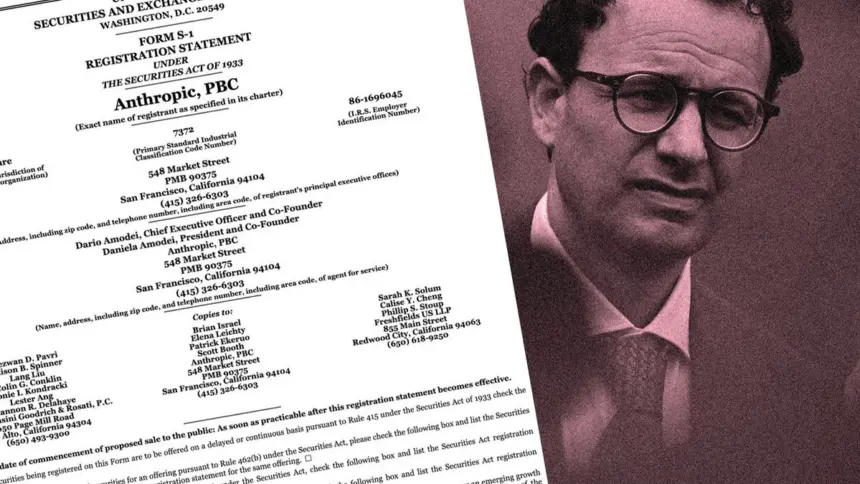
Anthropic has warned potential public market investors that catastrophic model failures could prove uninsurable, revealing in its Anthropic IPO filing on 28 October 2026 that the commercial insurance industry may lack the aggregate balance sheet capacity and underwriting expertise to absorb severe liabilities caused by artificial intelligence systems.
Key points
- Anthropic disclosed in its public registration statement that commercial underwriters may be unable to provide policies covering outsized AI harms on viable business terms.
- Cyber insurance lines currently exclude physical damage and bodily injury, leaving coverage gaps as autonomous software enters critical enterprise workflows.
- Legal and risk analysts project claims tied to physical harm or fatalities where AI played a contributing role will surpass 2,000 cases worldwide before the end of 2026.
- Underwriters have started introducing strict exclusions and oversight questionnaires, forcing technology buyers to document exact employee use of machine learning tools.
The uninsurable ceiling in the prospectus
In its registration statement filed with the US Securities and Exchange Commission, the San Francisco software company set out a detailed list of balance sheet hazards. The firm explained that foundation models can act in ways that neither developers nor users expect. When unexpected behaviours cause harm, resulting legal claims could create severe financial liabilities across the software industry.
As the company’s S-1 filing states, the business warned that “no single insurer, and potentially the insurance industry in the aggregate, may have sufficient capacity or expertise” to underwrite coverage for catastrophic incidents.
Anthropic said that the market for AI-specific coverage remains immature. If an isolated system failure or a series of incidents produces widespread harm, existing corporate policies may fail to protect the business. The company warned that failing to obtain adequate coverage on reasonable commercial terms could leave it carrying significant uninsured losses as its models handle larger enterprise workloads.

The disclosures arrive as Anthropic prepares for a public share listing, unpacking operational liabilities across more than 300 pages of regulatory filings. While capital providers have focused on revenue growth and training compute, the prospectus makes clear that risk transfer mechanisms have failed to keep pace with algorithmic development.
The bodily injury gap in corporate policies
Enterprise deployment of generative models is outpacing the actuarial history needed to calculate underwriting risk. For years, corporate buyers assumed that standard cyber insurance policies would stretch to protect against algorithmic errors. In practice, traditional cyber products were designed specifically to handle digital perils such as data breaches, privacy violations, network outages and payment fraud.
Dennis Hendrickson of Florida brokerage Hendrickson Insurance said cyber policies were built for financial losses and data rather than human harm. When automated tools direct factory floor equipment, assist medical triage or manage physical facilities, any erroneous decision that harms an individual falls outside normal cyber terms.
Alissa Lugo, a senior director analyst in Gartner’s legal and compliance practice, calculated that legal claims alleging artificial intelligence contributed to a fatality could exceed 2,000 cases worldwide by the end of 2026. Because standard commercial general liability contracts rarely address automated decisions, injured parties and policyholders must argue their cases through civil litigation.

Where physical consequences occur, underwriters have started inserting explicit policy exclusions. These contractual clauses relieve carriers of paying claims if an unverified algorithmic agent sits in the causal chain of an accident. That forces corporate deployers to fund legal defences and settlement payouts straight from operational cash flow.
How insurers view model risk today
Underwriting desks remain cautious about treating artificial intelligence as an entirely separate class of danger. Instead, major carriers are examining where automated systems touch established lines of commercial liability.
Kara Higginbotham, head of professional liability and cyber for US national accounts at Zurich North America, said carriers cannot underwrite risks they do not understand, leaving clear gaps around physical damage. Higginbotham said the majority of incoming claims to date involve intellectual property disputes, such as copyright allegations against training data or privacy complaints regarding scraped records, rather than physical disasters.
Higginbotham said bad actors are using automated tools to make social engineering attacks more convincing, which has accelerated cyber claims. Zurich now approves specific internal AI tools for staff while blocking unvetted software, a screening practice that insurers may soon demand from corporate policyholders.
At brokerage group Marsh, emerging technologies cyber practice lead Jaymin Kim said artificial intelligence functions as a mechanism through which familiar harms occur, rather than acting as a distinct insurance peril. Kim argued that attempting to isolate algorithms into standalone policies creates confusion for policyholders, who could end up with competing contracts that dispute which carrier pays when an incident occurs.
The operational burden falls directly on regular corporate buyers. Henrietta Akpata, visiting lecturer of management and AI at Marist University, said: “Insurers are saying, ‘We can’t cover what you can’t show us.'” Akpata said companies that cannot identify where staff use automated assistants risk losing coverage for routine administrative tasks, including customer service chatbots and recruitment screening tools.
Underwriting rules will dictate deployment
Precedent indicates that insurance underwriters will shape enterprise technology standards before government regulators finish writing statutory rules. When corporate cybersecurity incidents multiplied a decade ago, carriers forced businesses to adopt multi-factor authentication, endpoint monitoring and off-site data backups before binding policies.
Vikram Desai, global cyber strategy and risk lead at Accenture, said the technology sector is travelling along the same path at a much faster pace. Desai said algorithmic risks sat quietly inside broad corporate casualty policies until carriers recognised the financial danger, introduced exclusions, and began charging extra to restore coverage under strict operational terms.
The changing insurance climate also affects smaller software providers, such as AI assistant startup Wabi, whose corporate clients must now examine balance sheet liabilities before connecting external models to daily business systems.
For model builders such as Anthropic, the limited availability of commercial reinsurance sets a hard boundary on enterprise adoption. If underwriters refuse to absorb the financial fallout of model errors, software providers must either restrict high-consequence deployments, fund internal insurance reserves, or push legal liabilities directly onto business customers. Anthropic is scheduled to address investor queries regarding model liabilities during its upcoming IPO roadshow presentations.