British technology operators planning major UK data centres are turning to dedicated gas-fired power stations to run upcoming artificial intelligence facilities, after being told National Grid upgrades could take up to 15 years. The stopgap fossil fuel plans threaten to undermine the country’s statutory goal of reaching net zero carbon emissions by 2050.
Key points
- Developers behind four planned hyperscale computing campuses in England and Wales are seeking permission to install onsite gas generators while they wait for grid connections.
- The energy market regulator, Ofgem, confirmed that data centre operators have requested 72 gigawatts of grid capacity, far outstripping the UK’s entire peak electricity demand of 45 gigawatts last year.
- If run continuously at their combined 1.3-gigawatt capacity, the four sites would emit an estimated 4.1 million tonnes of carbon dioxide each year.
- Ministers confirmed in the autumn Budget that developers will be allowed to generate their own power behind the meter while queueing for grid infrastructure.
Gas generators as a stopgap for AI compute
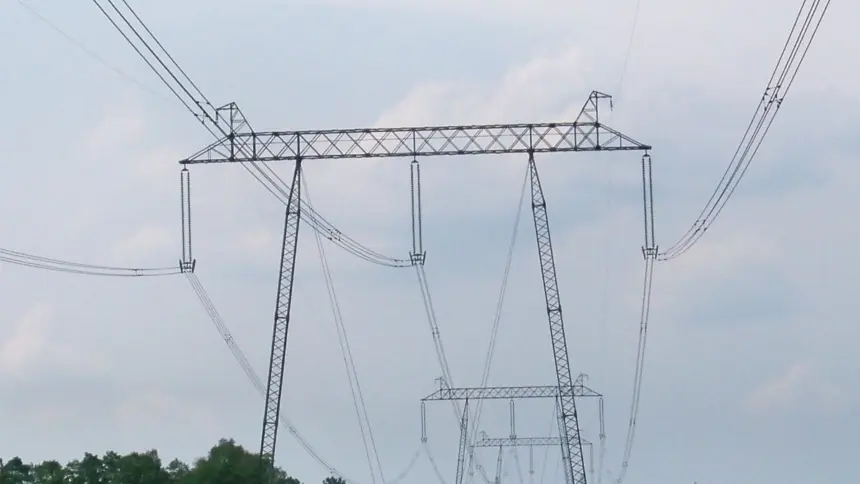
Surging computational demand from machine learning models has collided with a bottlenecked power transmission system across the British countryside. To bypass grid connection queues that stretch beyond 2035, developers have drafted plans for dedicated gas turbines and reciprocating engines beside their server halls.
An investigation by BBC File on 4 found that four large facilities are already pursuing onsite fossil fuel generation. Running at full capacity, these four campuses would draw 1.3 gigawatts of power. Environmental analysts calculate that their combined output would generate roughly 4.1 million tonnes of carbon dioxide each year, exceeding the combined municipal emissions of Manchester, Liverpool and Southampton.
The shift follows an announcement in the recent Budget, in which Chancellor John Healey introduced the British Data Centre Covenant. The policy aims to extract local community investments and water protections from operators in exchange for priority access to the power network. However, the Treasury also permitted developers to build temporary, behind-the-meter generation facilities when standard grid connections are unavailable.
The dilemma mirrors tensions across Europe and North America, where power grid constraints and data centre growth have triggered political debate over whether artificial intelligence workloads should take precedence over domestic electrification and decarbonisation.
The four sites queueing for capacity
The projects planning onsite fossil fuel power range from edge facilities near major cities to sprawling regional campuses. At Acre Slough, situated west of London in Europe’s most concentrated data corridor, developers have proposed installing gas engines with an output of up to 49.5 megawatts. Planning submissions indicate the site faces a wait of at least 10 years for a National Grid substation hookup.
Further northwest, beside the M40 motorway in Buckinghamshire, developers at Wapsey’s Wood have proposed building a 200-megawatt gas-fired generating station. Local planning documents show sufficient regional grid transmission capacity is not expected until 2040, meaning the facility could burn fossil fuels for up to 14 years before switching to cleaner grid electricity.
Ed Gemmell, an independent councillor in Buckinghamshire and leader of the Climate Party, warned that the proposal creates a dangerous planning precedent. He told the BBC that permitting dedicated fossil fuel plants beside computing halls would jeopardise legally binding local and national emissions targets.

In Wales, a prospective data campus in Cardiff is seeking permission for an energy centre equipped with gas turbines rated at up to 49.9 megawatts. The developer, Curtis Hall, described the turbines as a worst-case scenario designed to run for up to five years if transmission links remain stalled.
The largest proposed facility is Quest Park, located in a former quarry in Bedfordshire next to a planned theme park. The project envisions an operational power draw of 1 gigawatt, roughly equivalent to the electricity consumed by 250,000 British homes. Similar to the scale envisioned for next-generation AI compute campuses elsewhere, the sheer size of the facility creates severe logistical hurdles for clean energy procurement.
David Kohler, a director at Quest Park, told the BBC that powering the 1-gigawatt site entirely with solar panels would require covering roughly 15% of Bedfordshire in photovoltaic arrays. He said wind generation remains intermittent, though the company is reviewing non-combustion alternatives while finalising its energy strategy.
Local communities face pollution and noise
Local advocacy groups have raised alarms about the environmental and neighbourhood costs of running large combustion turbines next to residential communities. Oliver Hayes, head of campaigns at the charity Global Action Plan, told the BBC that installing private turbines would introduce intense local air pollution, persistent noise and heavy demands on municipal water networks for cooling.
Similar conflicts have emerged in the United States, where data centre noise disputes have prompted operators to buy out nearby homeowners affected by continuous generator hum. British environmental groups argue that placing commercial gas turbines outside the regulated utility supply chain shifts these industrial burdens directly onto neighbouring towns.
A 72-gigawatt queue strains the National Grid
The queue of operators seeking power connections highlights the wider scale of the infrastructure deficit. Ofgem, the energy market regulator, reported that data centre developers have submitted formal applications requesting 72 gigawatts of connection capacity.
To put that figure in context, peak power demand across the entire United Kingdom stood at 45 gigawatts last year. Even if only a fraction of the queued facilities are completed, their power requirements will reshape the national energy balance sheet.
Nathan McWhinnie, head of market intelligence and oversight at Ofgem, said the transmission network was operating at capacity across multiple regions. He observed that individual hyperscale developments now require the same electrical infrastructure as medium-sized industrial cities.
The scale of that demand has created friction between industrial policy and environmental regulation. Toby Perkins, the Labour MP who chairs the Environmental Audit Select Committee, criticised the government’s openness to local gas generation, arguing that ministers should not allow operators to use unchecked fossil fuels simply to attract digital investment.
International observers are watching the situation closely. Across the Atlantic, AI data centre electricity demands have become a central political argument, with local residents protesting against rising utility bills and neighbourhood air pollution tied to captive power infrastructure.
How ministers plan to control emissions
Government officials maintain that the UK cannot afford to slow construction while the grid catches up. Halting new development would prompt technology multinationals to move capital, operational jobs and critical computing workloads to other jurisdictions.
A government spokesperson said data centres form an essential pillar of the modern economy, supporting public healthcare systems, retail banking and commercial research. Ministers argue that the British Data Centre Covenant will ensure operators pay their fair share of transmission upgrade costs while shielding water tables from industrial cooling towers.
The Department for Energy Security and Net Zero insisted that behind-the-meter generation will be restricted. Officials stated that onsite fossil fuel generation will be time-limited and reserved for strategic infrastructure projects that cannot obtain grid connections through conventional upgrades.
All four development teams identified in the BBC investigation stated that they intend to decommission or scale back their gas systems once National Grid links become available. Until transmission lines are built, however, the race to train and host frontier AI systems will rely on the fossil fuels the UK pledged to leave behind.