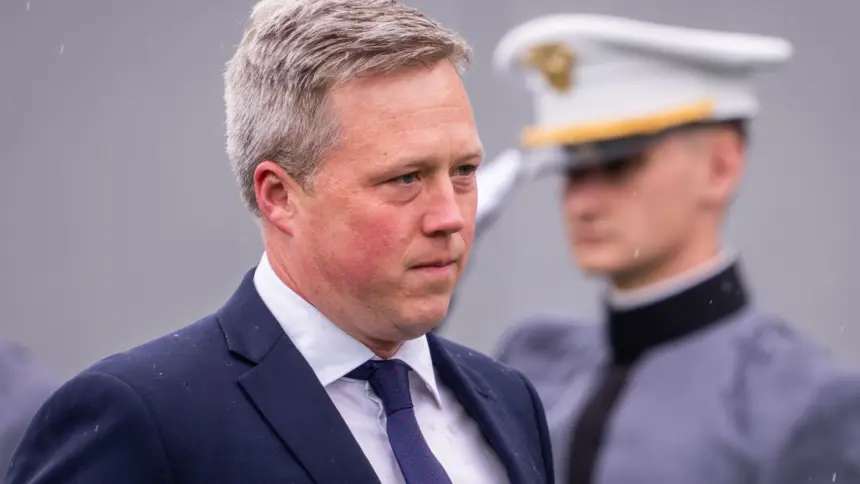
OpenAI hires Dan Driscoll, the former United States Secretary of the Army, as its senior counselor for national security modernisation. The newly created post tasks the former service secretary with advising leadership on military applications, cybersecurity, and working with allied governments as international competition over artificial intelligence intensifies.
Key points
- Former US Army Secretary Dan Driscoll has joined OpenAI as senior counselor for national security modernisation.
- The new role focuses on defence operations, cyber defence, and assisting allied nations with AI adoption.
- Driscoll will help bridge commercial product teams with military needs, including OpenAI’s Daybreak cybersecurity initiative.
- The appointment follows Driscoll’s resignation from the Pentagon in August after policy disputes over military modernisation.
A direct bridge between OpenAI and the military
In an announcement detailing the appointment, OpenAI said Driscoll will provide strategic guidance on how frontier models can strengthen both national security and cyber defences. He will work directly with executive leadership, government agencies, academic researchers, and foreign partners.
Chief executive Sam Altman framed the move around international standards. Altman said the US has “an extraordinary opportunity to work with other countries to spread the adoption of democratic AI,” arguing that Driscoll’s experience will help reinforce American technological influence.
Driscoll stated that national security demands are shifting rapidly, requiring public agencies to adapt. He argued that large models can streamline administrative burdens, improve intelligence processing, and speed up decisions for defence personnel. “The people who serve deserve the very best tools we can put in their hands,” Driscoll said.

The role represents a deliberate push by OpenAI to establish formal ties with Western military and security institutions. Rather than operating purely as a software supplier through enterprise contracts, the company is positioning experienced defence leaders to guide its development roadmaps for public-sector use.
From the Pentagon to private technology
Driscoll served as the 26th Secretary of the Army, where he directed operations, budgets, and procurement for roughly one million active-duty, National Guard, and Reserve soldiers, alongside more than 265,000 civilian employees. His public-sector record also includes service as acting director of the Bureau of Alcohol, Tobacco, Firearms and Explosives.
An Iraq war veteran who served in 2009, Driscoll earned the Combat Action Badge and Army Commendation Medal before completing a law degree at Yale Law School, according to a biographical profile from his alma mater, the University of North Carolina at Chapel Hill. He subsequently worked in private finance at investment bank BlackArch Partners in North Carolina.
During his tenure leading the Army, Driscoll prioritised technological overhaul and rapid procurement reform. He led initiatives to accelerate the delivery of battlefield systems, including programmes to expand access to drone and counter-drone technologies among international partners.

His diplomatic remit also extended directly into wartime coordination. In November 2025, Driscoll met with Ukrainian President Volodymyr Zelenskyy in Kyiv to examine American proposals for military assistance and diplomatic strategy, according to records released by the Ukrainian presidency.
Driscoll left the Pentagon in August after recurring disagreements with Defense Secretary Pete Hegseth over the direction of Army modernisation and personnel decisions, including disputes linked to the dismissal of senior officers such as Army Chief of Staff Randy George.
Aligning military operations with Project Daybreak
At OpenAI, Driscoll’s remit connects directly to existing cyber defence programmes. The company has sought to prove the utility of automated code generation and reasoning engines in securing digital infrastructure rather than facilitating offensive cyber operations.
Central to this effort is the Daybreak cyber defence initiative, a framework designed to protect critical infrastructure, utility providers, and public services from state-sponsored attacks. The programme combines reasoning models, the Codex coding harness, and security tooling into a supervised defensive platform.
Daybreak operates as a structured cycle: asset discovery, dynamic vulnerability validation, patch generation, and automated verification. Human analysts review proposed remediations before deployment, ensuring that autonomous tools cannot alter production networks without explicit administrative sign-off.
OpenAI has committed $1 billion in subsidised access under the Daybreak initiative over six months. The programme targets state and local government agencies, essential service providers, and open-source software maintainers who lack the resources to defend complex digital perimeters against foreign adversaries.
Driscoll’s background in acquisition and operational command will inform how these defensive stacks are tailored for allied militaries, whose IT environments are far more fragmented than commercial enterprise clouds.
The wider push into defence and policy scrutiny
Commercial AI developers have steadily softened earlier restrictions against military contracts, competing directly for Pentagon funding and intelligence community tenders. Anthropic, Google, and Microsoft have all pursued government partnerships, pitching generative models for analysis, document classification, and tactical communications.
The convergence of frontier AI models and defence operations has drawn growing political scrutiny in Washington. Lawmakers have repeatedly questioned whether commercial systems are dependable enough for mission-critical deployments, with US lawmakers demanding protections and model pause measures when internal safety concerns arise.
Driscoll’s arrival gives OpenAI a veteran operator who understands both Pentagon procurement bureaucracy and Capitol Hill dynamics. His long-standing personal relationship with Vice President J.D. Vance, a former Yale Law School classmate, also gives the company valuable political fluency within the current administration.
His immediate priority will involve coordinating discussions between OpenAI’s technical staff and allied defence ministries across Europe and the Indo-Pacific. Those talks are expected to focus on data sovereign hosting, secure workflow validation, and setting ground rules for defensive applications before commercial systems enter sensitive command chains.