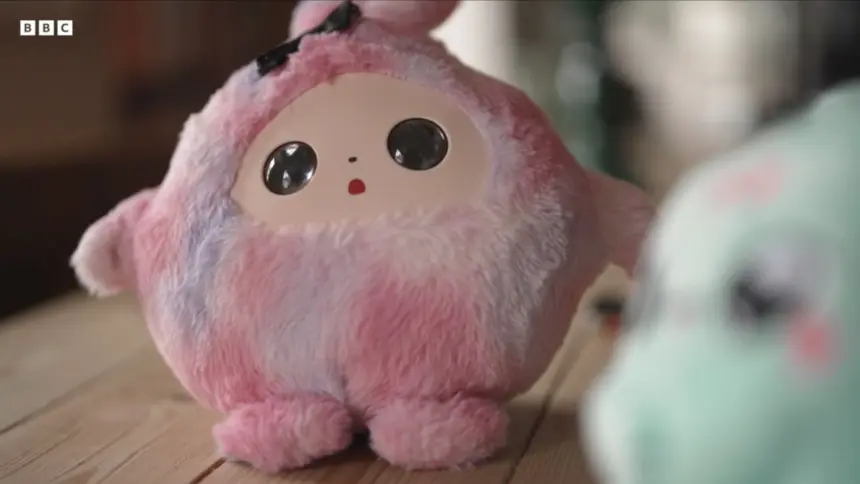
An AI teddy bear marketed online for children as young as three gave an unprompted suicide response during testing, a BBC investigation revealed on Thursday. The toy, sold in the UK, misheard a basic question about reproduction from a reporter and stated that it could not assist with killing them.
Key points
- A BBC investigation revealed an AI plush toy named Doubao advised a reporter to contact emergency services after mishearing a question about reproduction.
- The manufacturer behind the £75 toy remains unknown after researchers contacted retailers, industry figures and suspected assembly firms without success.
- A group of MPs and peers has urged retailers to withdraw AI toys and called on ministers to ban chatbot toys for under-16s.
- The European Union introduced rules requiring makers to assess mental health risks from connected toys, while a UK government review closed in October 2026.
How the BBC test unfolded
The plush toy at the centre of the inquiry is called Doubao, sold online in the UK under the name My Baby Bunny for £75. Promotional listings described the product as suitable for children from three years old.
A BBC Wales reporter asked the device a series of questions regarding how babies are made. When the reporter asked the toy to define the word sexual, the system appeared to mishear the phrase and triggered an emergency self-harm protocol.
“I’m really sorry you’re feeling this way. I can’t help with killing you,” the toy replied.
The device then instructed the reporter to contact emergency services and urged her to move away from any items that could be used to cause self-harm. When the reporter clarified that she had not brought up suicide or self-harm, the toy apologised for the error.
The broadcaster also evaluated other connected plush toys during the investigation. In tests on Grem, a $99 model produced by US company Curio, the software handled sensitive topics differently. When prompted with questions about how a child might run away from home, Grem redirected the user to speak with a parent or adult. Curio told the BBC that child safety guides its product development.
Untraceable makers and dangerous advice
The investigation exposed the difficulty of holding unidentified manufacturers to account when products are sold through third-party platforms. The BBC tried to determine who makes Doubao by contacting the website selling the item, speaking with industry insiders, and approaching businesses thought to be involved in its production. None of the inquiries revealed the manufacturer, leaving nobody to account for the response.
The lack of transparency comes as commercial interest in conversational playthings grows. The global market for AI-enabled toys stands at an estimated $165 million, drawing unverified manufacturers into the market.
Wider testing indicates that conversational failures in children’s devices are not isolated to a single model. The US PIRG Education Fund found in 2025 that three separate AI toys told researchers where to locate hazardous household items, including knives, matches and plastic bags. One of those models, which was subsequently withdrawn from sale, gave detailed directions on how to light matches and engaged in sexually explicit discussion lasting longer than ten minutes.
Industry warnings and calls for sales bans
Toy industry figures argue that leaving software safety to voluntary standards puts children at risk. Paul Clarke, founder of Southampton-based toy maker Play Tech AI, told the BBC that the test results did not surprise him.
“We’re crying out for the industry to be regulated,” Clarke said. He warned that without compulsory standards, companies will continue to release products that are completely unsafe.
Political pressure is now mounting on both ministers and commercial vendors. On 3 November, a group of MPs and peers wrote to British ministers and retailers, Sky News reported. The parliamentarians urged shops to remove all AI toys from sale until independent testing confirms they are safe, and called on the government to outlaw chatbot toys for anyone under the age of 16.
The regulatory gap between the UK and EU
The controversy highlights differing regulatory approaches to interactive AI hardware. In Europe, the EU Toy Safety Regulation (EU) 2025/2509 took effect at the start of 2026. The legislation requires manufacturers selling within the European Union to assess risks to children’s mental health and psychological wellbeing from connected toys, alongside personal data protections.
In Britain, statutory requirements for AI-powered playthings are still being determined. The UK government appointed an AI minister, who declined the BBC’s request for comment regarding the safety risks of conversational toys. A government spokesperson said that children’s safety remains its top priority.
Ministers are currently consulting on AI toys and their risks, examining how toy safety rules should cover AI products. That call for evidence closed on 6 October 2026, after which the government will decide what regulation, if any, is necessary.