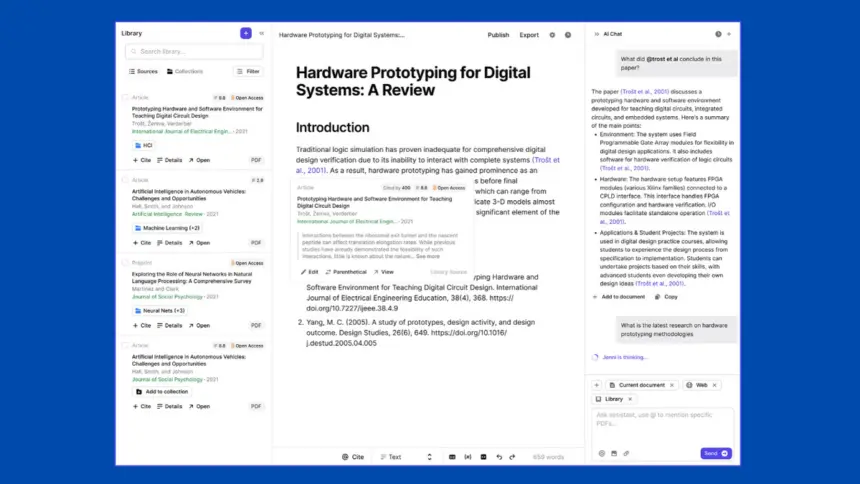
UK technology firm Digital Science acquires Jenni AI, an academic writing platform used by more than eight million researchers and students worldwide, the company announced on 29 October 2026. The deal links Jenni AI directly to the Dimensions research database to verify citations against 171 million published scientific papers.
Key points
- Digital Science has purchased Jenni AI, an academic assistant used across 189 countries, to integrate it with verified citation databases.
- The integration will allow users to verify generated references against 171 million publications indexed in Digital Science’s Dimensions platform.
- Jenni AI will continue operating as an independent product under its current name, leadership, pricing and subscription plans.
- The deal broadens Digital Science’s software suite alongside tools such as Overleaf, ReadCube and Papers AI.
Connecting drafts to 171 million papers
Under the terms of the acquisition, Jenni AI will begin integrating data from Digital Science over the coming months. The primary addition is full-text search and indexing from Dimensions, an academic database containing 171 million research publications. This connection gives the writing assistant a direct index of published scientific literature.
Jenni AI, founded in 2020 by David Park and Henry Mao, helps students and academics move from early research concepts to completed manuscripts. Users upload existing papers or import reference libraries to examine sources, write drafts, revise arguments, and check citations against original texts. Digital Science said the platform combines generative text drafting with source discovery and citation checking.
The company intends the integration with Dimensions to ground user drafts in the verified scientific record. Rather than suggesting literature from broad training weights, the system will verify suggested citations against actual journal articles, book chapters and conference proceedings.

The problem of citation hallucination
General-purpose generative AI systems frequently invent academic references, author lists and digital object identifiers. In academic and scientific publishing, these invented citations create serious risks for peer review and research integrity.
Stephen Leicht, chief executive of Digital Science, said researchers now use artificial intelligence as a normal working habit. Leicht said: “What they can’t get from a general-purpose tool is a citation that has been checked against the actual paper.”
Digital Science cited a September 2026 survey by Oxford University Press of more than 2,600 researchers. That study revealed widespread confusion about artificial intelligence policies in academia. The survey found that 74% of respondents were unsure which uses of AI software they needed to disclose, while 48% admitted they had not fully disclosed their use of AI tools in their work.
By tying drafting assistance to verified records in Dimensions, Digital Science aims to eliminate fictional citations. The system checks each reference against genuine publication metadata, allowing authors to show where their own analysis starts and where cited evidence begins.

Expanding the research software suite
The purchase adds another popular tool to Digital Science’s software portfolio. The London-based company already operates Overleaf, a collaborative writing service for LaTeX documents, alongside reference manager ReadCube and data analysis tool Papers AI. Its broader operations include Altmetric, Figshare, Symplectic and Writefull.
Digital Science said the acquisition strengthens its ties with master’s and doctoral students early in their careers. By providing writing software during graduate studies, the firm hopes to retain those researchers as they move into funded university laboratories, government posts and industrial research teams.
David Park, chief executive of Jenni AI, said: “We started Jenni with the belief that the future is written with AI, not by AI.” He said joining Digital Science helps give researchers reliable tools to publish verified work.
Product continuity and integration plans
Jenni AI will continue operating as a standalone application. Digital Science confirmed that the startup’s existing staff will remain in place, led by founders David Park and Henry Mao alongside executives Marc and Shailesh.
Subscription tiers and pricing for existing Jenni AI users will remain unchanged following the deal, according to Digital Science’s announcement. The companies have not disclosed the financial terms of the transaction.
Engineers from both organisations have started work on the backend connection between Jenni AI’s writing interface and the Dimensions search index. Digital Science said it will roll out the combined search and verification features gradually to users over the next few months.