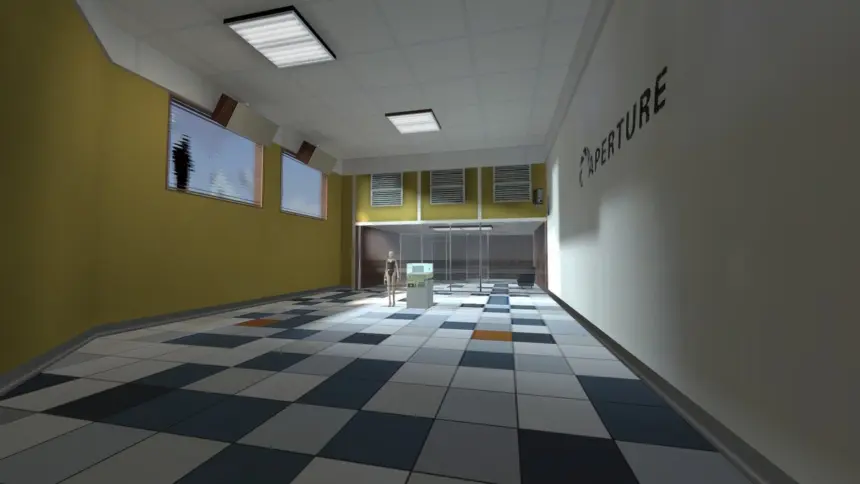
A fully functional build of the cancelled Portal prequel F-Stop has emerged online after gaming archivists assembled leaked source code and design files. The unofficial release, assembled by members of the community, offers the public its first direct look at the experimental photography puzzle mechanics that Valve abandoned nearly two decades ago.
Key points
- Community archivists assembled a playable build of F-Stop using recently leaked source code and map data alongside a 12-terabyte archive leaked in August.
- F-Stop replaces Portal’s portal gun with an instant camera that captures physical objects and duplicates or alters them in the environment.
- The game originated during Valve’s internal Directed Design Experiments in 2007 before the company transferred select concepts into Portal 2.
- The unofficial campaign runs for less than an hour and remains largely stable despite missing some dialogue and surface textures.
How archivists assembled the lost project
The playable version marks the resolution of a long search by digital preservationists tracking Valve’s unreleased internal projects. In August, an anonymous leak distributed more than 12 terabytes of internal Steam files. That upload contained early development repositories for several high-profile Valve titles, including Half-Life, Left 4 Dead and Portal 2. The archive also held art assets, models and audio files associated with F-Stop, but lacked the core engine files required to assemble the game into an interactive state.
The missing elements surfaced this week on the Valve Cut Content Discord server, where anonymous contributors uploaded the original map files and C++ source code. Technical volunteers quickly compiled the software by combining the newly obtained code with the graphical assets from the August breach. The resulting package enables modern PC users to run the experimental software natively for the first time outside Valve’s headquarters.
The camera mechanics behind F-Stop
F-Stop abandoned the teleportation mechanics of the original 2007 puzzle title in favour of an Aperture-branded camera. Players use the camera to photograph physical objects in the environment, storing them as instant film photographs in an inventory bar. When the player brings a photograph back into view, the game projects the captured object back into physical three-dimensional space.

By changing the player’s distance and perspective relative to the world, the mechanic alters the scale, orientation and placement of the duplicated items. A small block captured up close can be reprojected across a chasm as a massive platform. The system operates on spatial visual principles that later appeared commercially in independent puzzle games such as Viewfinder.
Testers describe the compiled software as surprisingly stable, though clearly unfinished. Several puzzle chambers lack completed textures, displaying standard developer placeholder grids, and multiple interactive sequences lack voice acting cues.
Origin in Valve’s design experiments
Valve conceived F-Stop during a structured creative initiative known internally as the Directed Design Experiments. Over a three-month span in 2007, the studio split its development staff into five independent teams tasked with prototyping distinct gameplay concepts without standard commercial constraints.
The experimental camera prototype impressed studio leadership enough to warrant consideration as a direct prequel to Portal. However, early playtesters expressed dissatisfaction with the complete absence of portals and the portal gun, leading Valve to shelve the project. The company later reassigned members of the team to develop what eventually became Portal 2, integrating select narrative threads and environmental concepts while leaving the camera mechanic behind.

Preservation and the status of abandoned software
Valve has never announced plans to commercialise or officially archive the F-Stop prototype. Large-scale source code leaks have repeatedly hit Valve’s intellectual property over the past two decades, beginning with the high-profile theft of early Half-Life 2 builds in 2003. While such security incidents present intellectual property and engineering risks for developers, they often provide computer science researchers and video game historians with rare documentation of scrapped interaction designs.
Community members continue to audit the leaked repository to repair broken script triggers and restore missing audio references. The current build functions on standard Windows systems without requiring specialized development hardware, serving as the definitive public record of one of gaming’s most storied developmental experiments.