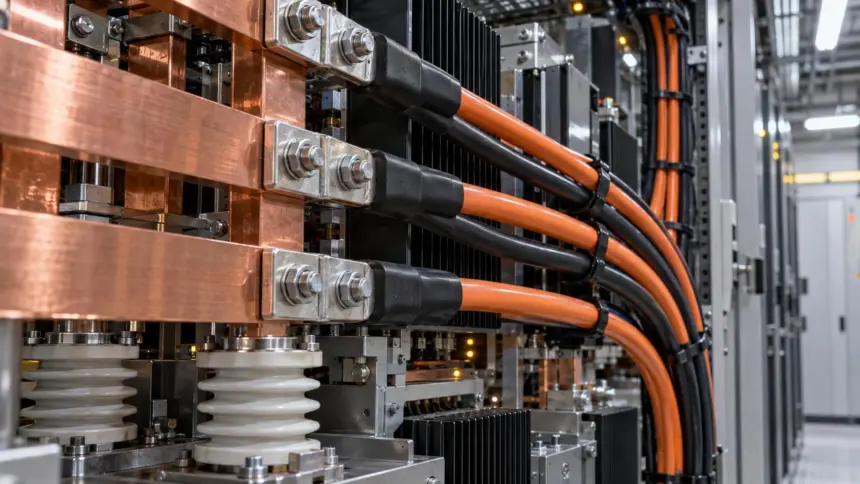
Envision has deployed an integrated 800V DC power system to run live artificial intelligence workloads at its Galaxy campus in Ulanqab, China, marking what the company calls the first commercial use of the architecture in a large-scale computing facility.
Key points
- The setup connects a 10-kilovolt medium-voltage alternating current feed directly to an 800-volt direct-current bus using solid-state transformers.
- Battery storage and software controllers absorb sudden power spikes caused by heavy graphics processor clusters.
- The site forms part of Envision’s Mission Gobi plan to build 5 gigawatts of desert-based computing capacity by 2030.
Solid-state transformers replace legacy conversions
Modern data centres typically bring high-voltage alternating current (AC) into a facility, step it down through bulky copper-wound transformers, and convert it multiple times before it reaches a computer chip as low-voltage direct current (DC). Each conversion loses power as heat and requires dedicated floor space for heavy equipment.
Envision said its setup cuts out several intermediate steps. According to its announcement on Monday, the system takes a 10-kilovolt medium-voltage AC supply and steps it directly down to an 800V DC bus. Solid-state transformers (SST), which use power semiconductors instead of large electromagnetic coils, manage this primary conversion.
From the 800V bus, downstream power electronics adjust the direct current to levels required by computing hardware inside the server rack. Envision stated that running direct current at 800 volts lowers resistance losses, reduces the volume of copper cabling needed throughout the hall, and shrinks the physical footprint of the electrical infrastructure.

Managing rapid GPU swings
Clusters of chips running large training runs create distinct electrical problems. When thousands of processors start or finish a compute cycle simultaneously, their power draw can spike or plunge within milliseconds. Standard electrical grids and traditional backup systems struggle to track these sharp changes.
To stop swings from tripping circuit breakers or destabilising upstream lines, the Ulanqab installation pairs the solid-state transformers with a battery energy storage system (BESS). The batteries provide instant, second-scale discharge to cover quick spikes and longer minute-scale support during broader supply interruptions.
A software controller, which Envision calls the Dubhe Controller, runs alongside the company’s Dubhe Energy Foundation Model. The software tracks power drawn by live workloads and directs the transformers and battery cells in real time, absorbing load variations locally before they can propagate back to the regional grid.
The Ulanqab Galaxy campus
The system is installed at Envision’s Galaxy campus in Ulanqab, an industrial hub in Inner Mongolia chosen by several Chinese technology firms for its cool climate and nearby wind and solar resources.
Envision initially commissioned the site on 6 August 2026, starting with a 120,000-square-metre supercomputing facility, according to its commissioning announcement. At the time, the firm designed the site to scale past 2 gigawatts of total electrical capacity. The latest update raises the planned capacity to 3 gigawatts, intended to run up to one million AI accelerators simultaneously at full build-out.
Direct connections to renewable generation are planned to supply more than 80 percent of the facility’s electricity. Marketing material on the Galaxy campus page shows the company offering tenants 10-year fixed power contracts at rates 20 percent below the local grid price, bundled with green electricity certificates and a direct green power supply ratio of 60 percent.
Desert computing plans
Data centre operators globally face limits on local grid interconnections. Power utilities in North America and Europe have pushed connection dates for large computing campuses into the 2030s, driving operators to evaluate alternative electrical topologies and remote generation hubs.
Kevin Huang, senior vice president of Envision Energy and head of its storage and computing power division, said the system links renewable supply directly with computing demand. The project serves as the operational template for Mission Gobi, an initiative Envision introduced at the VivaTech conference in Paris in June 2026.
Under that programme, Envision plans to develop 5 gigawatts of computing capacity across arid regions by 2030. The company argued that using a fraction of the world’s desert land for co-located solar, wind and high-density compute facilities can sidestep regional grid bottlenecks and deliver power at scale.