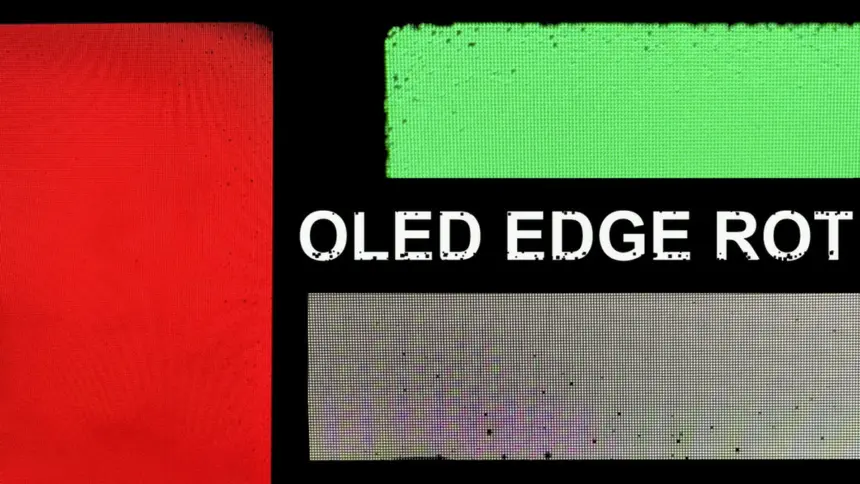
Accelerated testing has revealed that LG WOLED edge rot is disabling border pixels on older televisions after thousands of hours of operation. Hardware evaluation site RTINGS identified the defect across 14 of 16 WOLED panels, which Tom’s Hardware reported were manufactured between 2020 and 2022, while TechSpot dated them to between 2020 and 2023.
The findings came from an accelerated durability test that ran displays for 18,000 hours between 2022 and 2025. That operating time equates to roughly a decade of typical viewing in an average American home.
Instead of conventional burn-in, where static graphics leave persistent silhouettes on screen, the test monitors developed dead borders along their outer perimeters. The dark pixels expand inward in irregular patches resembling mould growth, gradually eating into the active picture area.
How does WOLED edge rot develop?
The failure appeared in 87.5 per cent of the tested LG sets, leaving only two displays untouched. RTINGS tracked the panels as part of its long-running longevity and burn-in test, which evaluates display degradation over extended periods.
For years, OLED buyers worried primarily about burn-in caused by static interface elements or news tickers. The RTINGS testing programme demonstrated that burn-in has mostly been mitigated for ordinary home use, appearing primarily under continuous 24/7 operation. Edge rot behaves differently, striking screen borders regardless of what content is displayed.
The problem is not confined to laboratory benches. Staff at RTINGS discovered the same edge rot developing on their personal televisions at home. User reports describing similar creeping dark spots have also surfaced across online forums, and Tom’s Hardware cited an instance of the defect appearing on a 2019 LG set owned by a contributor’s acquaintance.
The testing laboratory observed two separate physical symptoms around display edges. In addition to dark pixel clusters, several test panels suffered from edge delamination, where outer layers physically separate from one another.
RTINGS said the two problems appear to follow different timelines. Pixel failure seems to correlate with cumulative power-on hours, whereas panel delamination may depend on the calendar age of the hardware.
Moisture and encapsulation failure
In an investigation into edge rot across WOLED televisions, RTINGS said display specialists pointed to barrier breakdowns. Discussions with industry experts suggested that factory contamination, encapsulation flaws or the gradual deterioration of edge seals over time could allow moisture to seep into the panel.
LG addressed the findings in a formal statement to the researchers. The company said the issue “may occur in a very small number of OLED products under prolonged exposure to high-temperature, high-humidity, or other harsh environmental conditions.”
However, reports from regular living rooms challenge that assessment. Several affected units accumulated normal household operating hours in temperate indoor conditions rather than extreme laboratory stress or high-humidity environments. In one case documented by Tom’s Hardware, a television used for approximately 30 hours a week over nearly seven years still developed dark border spots.
Samsung also responded to the research, pointing out that its QD-OLED panels in the test did not suffer border decay. The company said its proprietary Thin Film Encapsulation technique “[eliminates] the root cause of border degradation and [ensures] long-term edge-to-edge uniformity where traditional structures falter.”
RTINGS cautioned that its endurance trial included only three Samsung QD-OLED units, making the comparative sample size small.
Are older LG OLED TVs covered under warranty?
The longevity test results leave many existing owners without warranty protection. Most of the displays examined in the study were built between 2020 and 2022, placing them outside standard manufacturer coverage.
LG introduced a five-year panel warranty in 2021, but limited that coverage to higher-end models including its G, Z and M series. Owners of other models or sets bought before that policy took effect must bear any replacement costs themselves.
Whether newer television sets will develop similar border defects remains unknown. The RTINGS test monitored hardware between 2022 and 2025, which prevented researchers from assessing whether current panel designs withstand identical long-term use.
LG reportedly introduced improvements to its WOLED manufacturing process in 2024. Because simulating 18,000 hours of continuous operation takes several years, independent laboratory confirmation of whether those changes eliminate edge rot will take time to determine.