Seoul-based semiconductor startup FuriosaAI raises $620 million in Series D funding at a $2.9 billion valuation, securing fresh backing on Thursday from South Korea’s state growth fund and international venture firms to expand commercial production of its energy-efficient artificial intelligence inference processors.
Key points
- The fresh funding quadruples FuriosaAI’s corporate valuation to $2.9 billion.
- South Korea’s state-backed National Growth Fund contributed $280 million to anchor the round.
- The company plans to produce 20,000 chips this year and double that volume to 40,000 in 2027.
- Broadcom is co-developing a third-generation processor with the startup.
The Series D funding breakdown
FuriosaAI confirmed the $620 million round of funding on Thursday, lifting its valuation fourfold from its previous private mark. The nine-year-old firm, founded in 2017, drew substantial capital from domestic and foreign institutions looking for alternatives to market incumbent Nvidia.
South Korea’s National Growth Fund served as the lead investor with a $280 million cheque. The allocation forms part of a wider government initiative intended to strengthen South Korea’s domestic semiconductor supply chain and foster homegrown suppliers for AI infrastructure.
A coalition of international firms contributed an additional $110 million. That group included Cisco Investments, Abu Dhabi-based NeoFort Holding, Singapore-based QUDA Capital Partners, Jericho Capital, Worldline Capital and US fund Infinitum Partners. Domestic institutions supplied the remaining capital, with repeat investments from the Korea Development Bank, Kakao Investment and internet group NAVER.

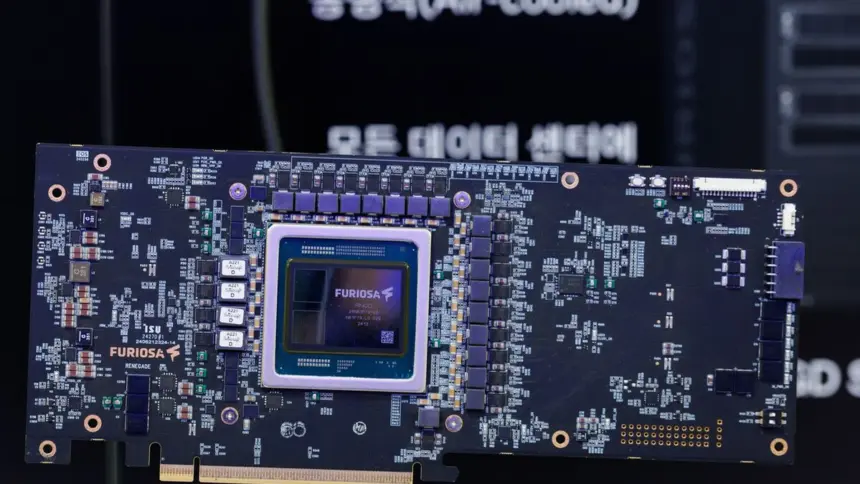
The capital injection will finance mass manufacturing runs for FuriosaAI’s second-generation inference silicon. The company stated that it will manufacture 20,000 processors this year and aims to expand that output to 40,000 units during 2027, with steeper increases planned thereafter.
How the architecture targets data centre power limits
FuriosaAI is pitching its hardware directly at data centre electricity constraints. Training modern foundation models demands substantial computing clusters, but running those models for paying users creates continuous operational demands on regional power networks and server cooling arrays.
Data centre operators face strict power envelopes that limit how many graphics processing units they can rack together. Because of this power wall, FuriosaAI focuses entirely on inference, measuring commercial success by token output per watt rather than raw floating-point calculations.
The core of FuriosaAI’s design is its Tensor Contraction Processor, deployed within the company’s second-generation RNGD architecture. Standard graphics chips rely on two-dimensional matrix multiplication, which forces large volumes of data back and forth across silicon memory layers.

FuriosaAI instead structures computations using higher-dimensional tensor contractions. Paired with deterministic execution on the silicon, this method reduces internal data movement. The company claims the design consumes less than half the electrical power of comparable Nvidia GPUs while running standard industry software frameworks including PyTorch and vLLM without code modifications.
Commercial rollouts in South Korea
FuriosaAI has already converted major South Korean conglomerates into operational clients. LG Group uses the startup’s processors to serve its proprietary EXAONE foundation models. AI software developer Upstage runs its real-time web search summary engine on the hardware, delivering queries to millions of active users.
Cloud distribution has also started domestically. Samsung SDS introduced a commercial service in mid-2026 that rents access to FuriosaAI neural processing units on demand. This allows corporate software teams to test workloads on alternative silicon without buying server racks upfront.
The push to trim inference expenses coincides with a wave of enterprise spending on automation. As software teams raise heavy rounds, seen when Serval raises $150 million to expand its enterprise AI agents or when enterprise AI agents startup Crux Labs raises $6m to capture human judgment, the cost of running millions of daily model inferences becomes the primary hurdle on profit margins.
Broadcom partnership and the next generation
Alongside its production push, FuriosaAI is working on its third-generation silicon. The company disclosed that it is co-developing the Gen 3 processor with American chip supplier Broadcom, aiming to refine manufacturing tolerances and memory bandwidth for larger reasoning models.
June Paik, co-founder and chief executive of FuriosaAI, said the investment allows the business to push into foreign markets. “We are entering a new phase of bringing our technology to the global AI infrastructure market at scale,” Paik said, adding that commercial RNGD deployment and Gen 3 development remain the company’s two operational priorities.
NAVER Ventures, which backed FuriosaAI at the pre-seed stage in 2017, maintained that the hardware has cleared the initial survival threshold. Partner Yong Jung Park said the startup has advanced past design validation and into volume commercial deliveries with established technology buyers.
FuriosaAI must now prove that its energy gains persuade Western hyperscalers and cloud operators to diversify their server hardware away from Nvidia’s entrenched ecosystem.