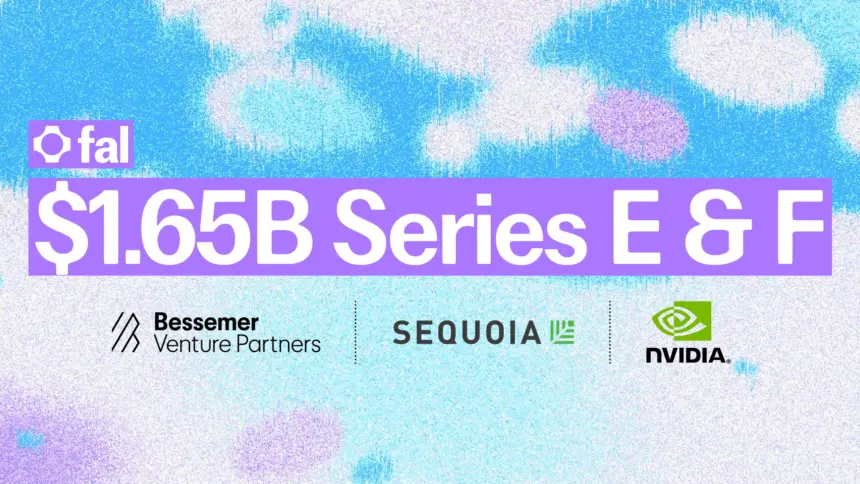
AI inference startup Fal has raised $1.3 billion in a fresh funding round led by Bessemer Venture Partners, doubling its valuation to $16 billion. The US-based infrastructure provider announced the transaction on Tuesday, securing capital from chipmaker Nvidia, Sound Ventures and T. Rowe Price Group to expand its computing infrastructure.
Key points
- Bessemer Venture Partners led the $1.3 billion round, which doubles Fal’s valuation from $8 billion to $16 billion.
- Nvidia, Sound Ventures and T. Rowe Price Group participated in the round alongside existing backers.
- Bessemer partner Talia Goldberg joins the board of directors following the investment.
- Fal will use the proceeds to secure additional computing power after hitting severe capacity constraints during the summer.
Scaling infrastructure under compute pressure
Fal runs developer infrastructure designed specifically to host and run generative media models. The platform allows software engineers and creative professionals to deploy open-source and proprietary models that generate images, video and audio through application programming interfaces.
The company arranged the transaction in October after experiencing an acute surge in customer demand. Burkay Gur, chief executive and co-founder of Fal, said the business had exhausted its available hardware capacity earlier in the year as usage outstripped supply.
“We hit a point in summer where we were not able to serve our customers and had to rate limit them,” Gur said. The fresh capital allows the company to reserve large clusters of specialized processors to satisfy sustained API demand.

Rapid valuation growth in six months
The $16 billion valuation marks a rapid escalation for the company, which raised $350 million in April in a financing round led by Sequoia Capital that valued the startup at $8 billion. Doubling that figure within six months reflects intense investor competition to fund operational infrastructure in the artificial intelligence sector.
As part of the latest agreement, Talia Goldberg, a partner at Bessemer Venture Partners, will take a seat on Fal’s board of directors. Bessemer had previously backed the startup in earlier financing stages before choosing to lead the new multibillion-dollar round.
Hardware maker Nvidia joined the round as a strategic investor alongside asset manager T. Rowe Price and venture firm Sound Ventures. Nvidia’s direct participation gives Fal a close financial tie to the primary supplier of the graphics processing units that power generative workloads.
The shifting economics of model inference
Fal’s expansion highlights a broad reallocation of capital across the tech industry toward inference, the process of running trained artificial intelligence models for end users. While initial venture funding concentrated on model developers training massive foundational systems, recurring operational costs increasingly stem from real-time generation queries.

Specialized inference providers have attracted substantial attention from venture firms as software companies seek to outsource hardware management. Rivals such as Modal and Baseten have also held discussions to raise capital at elevated private valuations, according to reports by Bloomberg News.
The broader market for serving models has also spurred heavy investment in custom silicon alternatives. Earlier this year, FuriosaAI raised $620 million to design dedicated inference accelerators to reduce operating expenses and reliance on Nvidia hardware. At the software layer, application makers such as AI assistant startup Wabi continue to raise capital to support the compute required to deliver daily workflows.
Market demand for generative media
Demand for media generation has accelerated as software developers integrate real-time image and video capabilities into consumer applications, games and marketing software. Running these diffusion and transformer architectures requires low-latency execution and high memory bandwidth, which generic cloud providers often struggle to provide cost-effectively.
By managing server allocation, model weights caching and batch optimization, inference platforms offer developers lower per-generation prices than standard infrastructure instances. However, maintaining those performance levels requires massive upfront capital commitments to reserve data centre space and high-end silicon months in advance.
With $1.3 billion in new capital, Fal enters the final months of the year with sufficient funding to secure long-term server contracts and scale its engineering team. The company will now focus on deploying that capacity to clear hardware backlogs and onboard waiting enterprise clients.