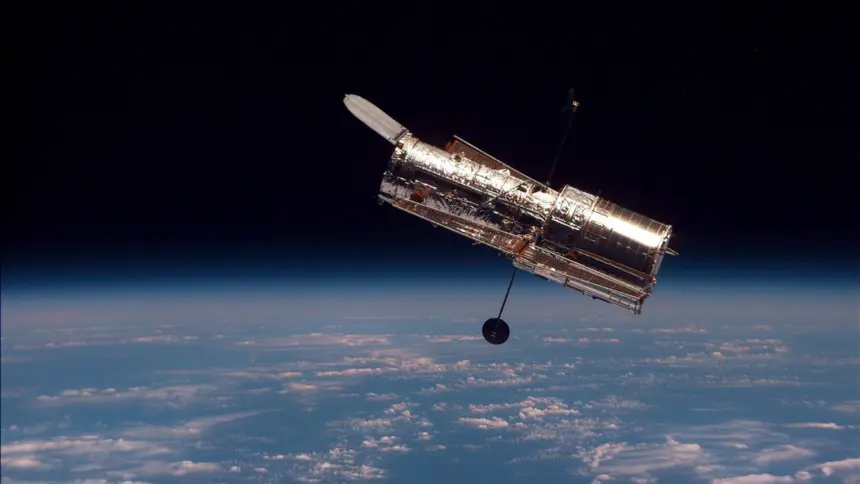
NASA has asked commercial space companies for proposals to boost the decaying Hubble Space Telescope into a higher orbit, service its instruments or steer it into a controlled atmospheric re-entry. The agency issued a formal request for information on 29 October, setting a deadline of 30 November as the observatory continues to lose altitude.
Key points
- NASA wants private space firms to submit plans to lift Hubble above 600 kilometres, upgrade its hardware or dispose of it safely.
- The telescope orbits at roughly 470 kilometres without onboard engines and faces a 50 percent chance of re-entry by December 2033.
- Any rescue or disposal flight must launch by 2032, though the agency has not committed funding or guaranteed a contract.
- The initiative follows the imminent loss of the Swift observatory after a commercial docking attempt failed.
The race against orbital decay
The Hubble Space Telescope has spent 36 years in low Earth orbit gathering observations across visible and ultraviolet wavelengths. It relies entirely on external assistance to maintain altitude because it carries no propulsion system of its own.
Atmospheric drag has steadily pulled the observatory down from the 583-kilometre orbit established by the Space Shuttle Columbia during a servicing mission in 2002. Hubble now circles the Earth at roughly 470 kilometres, sinking lower as solar activity heats and expands the upper atmosphere.
Agency calculations indicate that the chance of uncontrolled re-entry reaches 10 percent by September 2032 and 50 percent by December 2033, The Register reported. Any operation to lift or safely steer down the spacecraft must fly before the end of 2032 to avoid an unguided fall.

Hubble is heavy enough that dense parts would survive atmospheric heating. An unguided crash would create a small but real hazard for people and property on the ground, making controlled disposal necessary if a reboost does not happen.
What NASA wants from industry
The official request for information outlines three distinct paths for commercial participants. Companies can propose raising Hubble to an orbit of at least 600 kilometres, conducting maintenance to prolong scientific work, or conducting a controlled de-orbit manoeuvre.
According to requirements reported by Ars Technica, any contractor must supply the launch vehicle, the servicing spacecraft and all operational control systems. If a crew is required, the vendor must provide the human spaceflight architecture as well.
The commercial provider must also ensure the rendezvous and docking process causes no structural or optical damage to the telescope. NASA outlined the terms in a commercial servicing call published on Friday.

NASA has not allocated money for the project, nor has it promised to buy any mission that emerges from the study. Jared Isaacman, the NASA Administrator, said that if cost-effective commercial solutions exist, “we owe it to the American taxpayer and the scientific community to explore them.”
Robotic servicing replaces crewed concepts
NASA previously studied commercial servicing concepts in 2022 after receiving eight responses to an industry survey. At the time, Isaacman offered to fund part of a crewed servicing flight using a SpaceX Crew Dragon capsule, but the agency shelved the plan in 2024 over safety and complexity risks.
The likelihood of sending astronauts to Hubble has fallen further. SpaceX plans to retire Crew Dragon by 2030, and NASA has turned to Boeing Starliner flights to meet astronaut transport obligations to the International Space Station.
Isaacman expects the latest request to attract interest from robotic servicing companies, Ars Technica reported. Startups in the sector have recently secured private funding to test orbital refuelling equipment and autonomous docking mechanisms.
Hubble holds one key operational advantage over other ageing satellites. Astronauts installed a mechanical soft-capture ring on its aft bulkhead during the final shuttle servicing mission in 2009, giving autonomous docking systems a standard physical latch point.
Lessons from the Swift mission
The urgency surrounding Hubble reflects recent problems with another orbital asset. NASA ceased science operations on the Swift observatory on 20 October after the satellite dropped below 275 kilometres.
Drag at that low altitude prevented Swift from maintaining steady pointing for astronomical observations. The agency published an update which expects the observatory to re-enter the atmosphere within weeks.
NASA had previously contracted a startup, Katalyst Space, to intercept Swift and push it into a sustainable orbit. The robotic servicer suffered technical failures and failed to reach the target, leaving the spacecraft to decay naturally.
The US Space Force now projects Swift will re-enter within days, the Associated Press reported. While atmospheric friction will destroy most of the satellite, dense tungsten shielding and mirror assemblies will strike the ocean surface.
The scientific stakes
Astronomers rely on Hubble because no operating space telescope duplicates its broad ultraviolet and visible imaging performance. The James Webb Space Telescope works primarily in the infrared spectrum and cannot replace those capabilities.
NASA does not plan to launch a comparable visible and ultraviolet flagship until the Habitable Worlds Observatory missions scheduled for the 2040s. A gap of a decade or more would leave researchers without access to high-resolution ultraviolet data from space.
Commercial firms have until 30 November to submit technical concepts, after which NASA engineers will assess whether any private design can safely reach Hubble before atmospheric drag seals its fate.