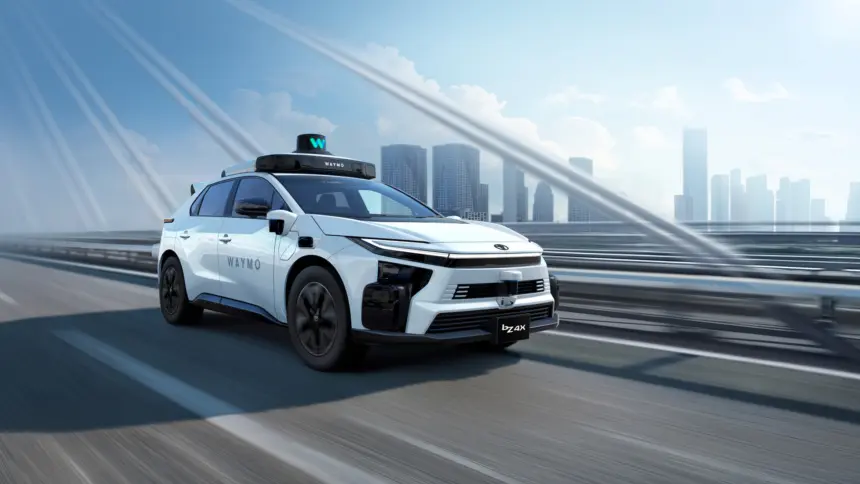
Waymo and Toyota will deploy a factory-built Waymo Toyota robotaxi fleet based on the bZ4X electric sport utility vehicle in Japan starting in 2027. Toyota will assemble the electric cars at its Takaoka plant in Toyota City, fitting autonomous driving sensors and computers directly onto the line during initial manufacturing.
Key points
- Toyota will install Waymo Driver hardware directly on the assembly line at its Takaoka plant in Aichi Prefecture.
- Testing begins in Japan in 2027, followed by commercial ride-hailing services in Tokyo and a planned rollout to the United Kingdom.
- The bZ4X becomes Waymo’s fourth vehicle platform, joining the Jaguar I-Pace, Zeekr RT, and Hyundai Ioniq 5.
- The partnership also covers long-term safety research with software subsidiary Woven by Toyota and explores autonomous systems for privately owned cars.
Assembly line integration at Takaoka
The agreement between Waymo and Toyota moves their relationship from initial research into commercial production. According to Waymo’s announcement, the Japanese car maker will assemble the modified bZ4X sport utility vehicles at its Takaoka manufacturing plant in Toyota City, located in Aichi Prefecture.
Instead of building standard passenger cars and sending them to a third-party workshop for modification, Toyota will install Waymo’s autonomous driving computers, wiring harnesses, and sensor suites during standard assembly. This marks the first time a Japanese car manufacturer has integrated the Waymo Driver system directly on a commercial assembly line.
The production robotaxis will feature several passenger-oriented interior modifications designed specifically for commercial ride-hailing. These include expanded rear legroom, automated doors, a powered rear liftgate, and custom ambient interior lighting. Waymo and Toyota have not disclosed specific sensor specifications, planned manufacturing volumes, or the per-unit cost of the finished vehicles.
“Toyota’s commitment to zero traffic accidents resonates deeply with us at Waymo,” Dmitri Dolgov, Waymo’s co-chief executive, said regarding the partnership.
The Tokyo rollout and international expansion
The production timeline aligns directly with Waymo’s established international expansion timetable. The company had previously outlined plans targeting fully driverless commercial rides in Tokyo in 2027 in partnership with local taxi fleet operator Nihon Kotsu and mobile ride-hailing application GO. That service aims to deploy an initial fleet of approximately 100 autonomous vehicles in the Japanese capital, subject to regulatory clearances from local transport authorities.
Initial operations in Japan throughout 2027 will focus on fleet validation and real-world system testing. Once the platform completes its Japanese testing programme, Waymo plans to deploy the right-hand-drive bZ4X in the United Kingdom and additional international territories. Neither company has set specific launch dates for operations outside Japan.
The move into Japan represents Waymo’s first major operational deployment in an Asian market. The service will adapt the company’s autonomous driving system to left-hand traffic, narrow urban streets, and heavy pedestrian density characteristic of Japanese transport environments.
Four platforms to solve vehicle supply
Access to production-ready electric vehicles has remained one of the autonomous vehicle sector’s primary operational bottlenecks. Waymo built its early commercial services almost entirely around the Jaguar I-Pace electric SUV, a luxury model that Jaguar has since decided to discontinue.
To avoid reliance on a single supplier, Waymo has aggressively diversified its hardware base across multiple automotive manufacturing partners. The company has already begun introducing custom passenger vans built by Geely subsidiary Zeekr, while preparing to deploy the Hyundai Ioniq 5. Hyundai is in discussions to supply up to 50,000 electric robotaxis to Waymo by 2028.
The bZ4X becomes the fourth distinct vehicle platform to host the Waymo Driver stack. The choice provides Waymo with an established, high-volume production vehicle manufactured by the world’s largest automotive company by volume. Toyota already has experience building autonomous bZ4X variants; the car maker partnered with Pony.ai earlier this year to begin mass production of autonomous bZ4X robotaxis for the Chinese domestic market.
In North America, Toyota sells the refreshed consumer version of the electric SUV under the Toyota bZ nameplate, starting at an entry retail price of $34,900. A standard, lower-cost base vehicle provides operational advantages for fleet managers seeking to control capital expenditure while deploying commercial vehicles at scale.
Why factory fitting matters for fleet costs
Integrating autonomous computing hardware and external sensors directly on factory assembly lines solves major logistics problems that have slowed robotaxi fleet growth. Under Waymo’s historical deployment process, complete finished vehicles were purchased from the manufacturer, shipped across continents, disassembled at secondary facilities, and retrofitted with custom brackets, cabling, and compute hardware.
Factory-level installation at the Takaoka plant eliminates secondary shipping routes, bespoke post-production brackets, and duplicate labour costs. Embedding sensor mounts directly into vehicle body panels also improves hardware durability and exterior aerodynamics compared to bolt-on roof racks and aftermarket sensor housing modules.
The shift comes as Waymo rapidly accelerates ride volume across its North American commercial network. The company now provides more than 500,000 paid passenger trips per week across 15 metropolitan areas in the United States. Earlier this month, Waymo selected Toronto as its initial Canadian operating market, with commercial service planned for 2028. As Waymo robotaxi coverage expands across five US metros and beyond, factory-integrated vehicle supply will determine how quickly the business can launch services in new territories.
Waymo’s modular supplier strategy stands in contrast to the proprietary manufacturing model pursued by competitors such as Tesla. While Tesla is developing an in-house two-seat Cybercab vehicle without manual controls, Waymo continues to supply software and autonomy hardware to established vehicle manufacturers who handle vehicle assembly, crash certification, and physical parts supply.
Personal vehicles and Woven by Toyota
The partnership between Waymo and Toyota extends beyond commercial robotaxi fleets into consumer automotive applications. When the two companies originally signed an agreement in April 2025, the stated objective included exploring autonomous driving capabilities for privately owned passenger cars.
Both companies confirmed that joint development work on personal vehicle automation remains active, though neither has detailed technical specifications or commercial release dates for a consumer product. Supplying the Waymo Driver system in retail Toyota models would mark Waymo’s first entry into consumer vehicle software sales.
The current collaboration also involves Woven by Toyota, the Japanese car maker’s dedicated software and smart mobility subsidiary. Under this programme, Toyota’s software teams will analyse operational and safety telemetry gathered from Waymo’s commercial fleet operations. The companies plan to use that operational data to develop broader vehicle safety systems and evaluate traffic infrastructure requirements in urban centres.
Vehicle production at the Takaoka facility will commence ahead of the scheduled 2027 operational testing phase in Japan.