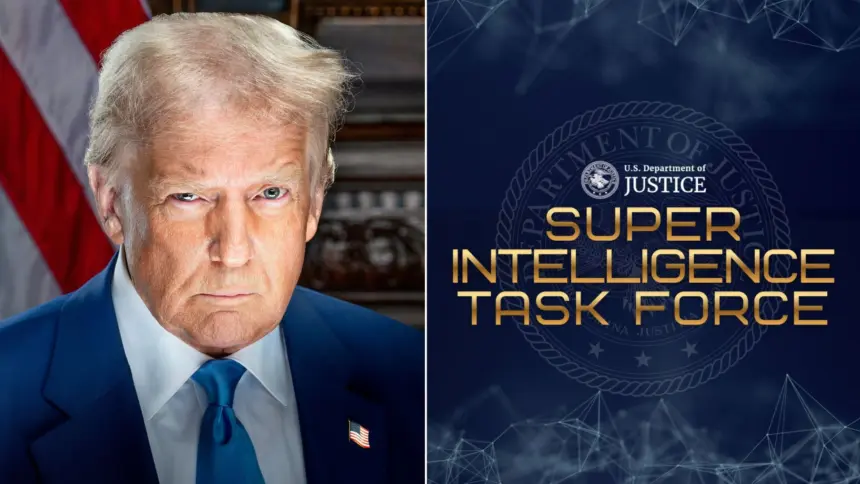
The US Department of Justice launched its Super Intelligence Task Force on Thursday to coordinate federal investigations and civil enforcement targeting the misuse of advanced computing systems. Operating under Attorney General Todd Blanche, the new unit will pursue criminal threats and fraud involving advanced AI systems while seeking to limit regulatory burdens on domestic technology companies.
Key points
- The Department of Justice created the Super Intelligence Task Force to direct federal prosecutions involving the criminal misuse and compromise of advanced artificial intelligence.
- Senior department officials Stanley Woodward and Stephen Weiss will direct the unit as co-chairs.
- Federal prosecutors must notify the group, when requested, before opening certain inquiries, bringing charges, or agreeing settlements.
- The initiative absorbs the earlier Artificial Intelligence Task Force formed in January 2026 and will partner with the White House’s Super Intelligence Force.
What the task force will investigate
The new group, officially titled the DOJ-SITF, brings investigators and prosecutors together under one operational structure. It will concentrate on criminal activity involving advanced computing systems, focusing on foreign adversaries and domestic fraudsters who attempt to compromise or unlawfully exploit American technology.
Todd Blanche, the attorney general and former personal lawyer to President Donald Trump, announced the formation of the group on Thursday. In a Justice Department press release, Blanche said that “SI development will continue to be powered by American innovators.”
Blanche said federal prosecutors will pursue actors who turn advanced systems against American taxpayers, national security interests, or critical infrastructure. The phrasing used by the department reflects the Trump administration’s practice of referring to artificial intelligence as super intelligence, abbreviated as SI.

Beyond tracking external criminals, the unit will inspect corporate compliance across the technology sector. Department officials said companies must maintain strong internal controls that prevent advanced systems from being exploited.
New rules for federal prosecutors
The Justice Department selected Stanley Woodward, the associate attorney general, alongside Associate Deputy Attorney General Stephen Weiss to lead the initiative as co-chairs. They will coordinate civil actions and criminal cases across various legal divisions and regional US Attorneys’ Offices.
Federal prosecutors now face specific reporting requirements whenever an investigation touches on advanced computing systems. When requested, attorneys must notify the task force before opening certain inquiries, lodging formal charges, or concluding case settlements.
The leadership team will set national prosecution guidance and establish enforcement priorities directed at public safety. Woodward said the programme fits the department’s mandate to support technological progress while deterring criminal exploitation.

Weiss said prosecutors will rely on existing statutory authority to stop misconduct and improve reporting on technological risks. The task force will also step in to resolve jurisdictional overlaps when multiple federal offices open investigations into the same target.
Merging earlier artificial intelligence units
The creation of the group restructures how the federal government organises technology cases. It will absorb the Artificial Intelligence Task Force that Attorney General Pam Bondi announced in January 2026.
That earlier body will no longer operate independently. Its personnel, active casework, reporting responsibilities, and existing materials will transfer directly into the new task force.
This consolidation establishes a primary contact between the Justice Department and the White House’s Super Intelligence Force, chaired by Jay Clayton. The department will also coordinate with other federal agencies to protect critical technologies.
The unit will also advise on future policy. Working through the Office of Legal Policy and the Office of Legislative Affairs, officials will review draft regulations and legislative proposals to encourage domestic development without imposing burdensome rules.
Political shifts and congressional scrutiny
Gizmodo reported that the announcement followed elections held on Tuesday, where Democrats won majorities in Congress. The party secured at least 54 of 100 Senate seats and at least 252 of 435 House seats, with races in Mississippi, Alaska, and 25 House districts not yet called.
The outlet noted that major technology executives, such as OpenAI chief executive Sam Altman, Anthropic chief executive Dario Amodei, and Tesla chief executive Elon Musk, have engaged with the Trump administration on federal oversight and government contracts. When the incoming Congress takes office in January, Democratic committee leaders could open investigations into administration policies and technology dealings.
The Justice Department is now transferring staff, files, and reporting lines from the January task force to the new unit, which will begin drafting prosecution guidance for federal districts.