The Google Dreambeans India rollout began on 3 November 2026, bringing the search giant’s experimental personal storytelling application to its first market outside the United States. Available on Android and iOS to users aged 18 and over, the software creates daily illustrated visual stories from personal activity across connected Google accounts in 14 languages.
Key points
- Google has launched Dreambeans in India on Android and iOS across 14 languages, its first international expansion since debuting in June 2026.
- The application connects to personal Google services including Gmail, Calendar, Photos, Search, and YouTube to generate illustrated stories without requiring text prompts.
- New features use Google’s Veo video model to animate select scenes and Nano Banana 2 to insert recognised faces from Google Photos into custom artwork.
- Users must pick a single language at a time, preventing mixed-language outputs such as Hinglish despite widespread multilingual usage across the country.
How Dreambeans builds daily stories
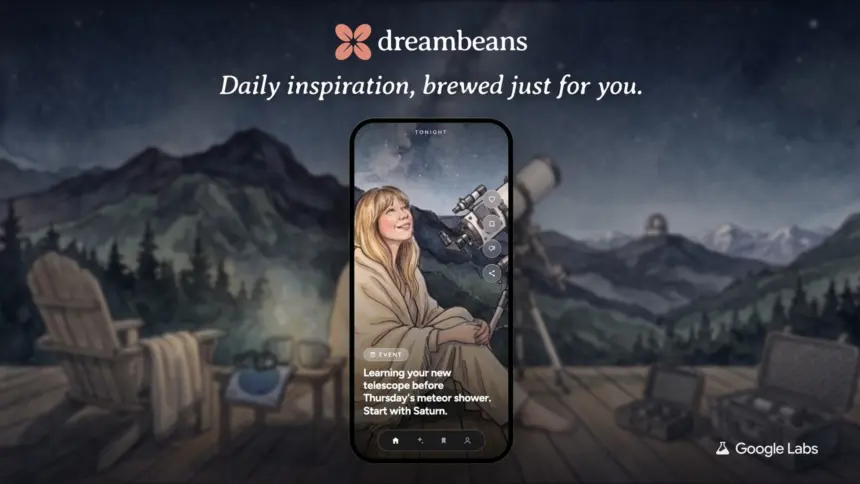
Google launched Dreambeans as an experiment inside Google Labs to test proactive, prompt-free artificial intelligence feeds. Rather than asking users to type queries into a text box, the app accesses background data from services they select, such as Google Calendar, Gemini, Gmail, Google Photos, Google Search, and YouTube.
To generate content, the system requires access to at least one supported Google service. The platform then uses Google’s Personal Intelligence system to scan for patterns, recent activities, and upcoming plans. According to Google’s official product FAQ, assembling the first collection takes up to 24 hours, after which the application delivers a single daily batch of visual updates rather than an endless scrolling feed.
A typical story collection might take a delivery confirmation email for pet supplies and combine it with a calendar entry for a weekend trip, yielding training tips, dog-friendly park recommendations, and route ideas. Each card can be opened for additional detail, bookmarked for later reading, or shared directly with friends and family.

Visuals play a central role in every entry. While early versions relied on static graphics, recent updates add video clips generated by Google’s Veo model to animate select cards. When stories involve the account holder or family members, the app uses Google Photos face grouping alongside a model called Nano Banana 2 to incorporate personalised character likenesses rather than generic figures.
Why Google chose India for its first international test
India represents the second-largest internet user base in the world and serves as an important proving ground for Google consumer products. The company said strong consumer interest and deep adoption of its core services made the country the natural choice for the app’s first market outside the US.
Gozde Oznur, a Google product manager, said during a press briefing that India stood out because of an unusually high overlap among users who actively rely on Gmail, Google Photos, and the Gemini assistant simultaneously. That intersection provides the Personal Intelligence framework with richer context than markets where users divide their digital lives across disparate platforms.
Language support formed the technical centrepiece of the Indian release. The rollout covers 14 languages in total. Users can read stories in English or pick between 13 Indian regional languages, spanning widely spoken tongues such as Hindi, Punjabi, Bengali, Telugu, and Tamil, alongside Marathi, Urdu, Gujarati, Kannada, Malayalam, Odia, Assamese, and Nepali.

However, the software carries a key linguistic constraint at launch. Users must select one language at a time for their daily drops. While the app can extract information from source emails and search queries written in multiple languages, it cannot generate stories that combine tongues within the same card. That limitation could hinder adoption in urban Indian centres where bilingual conversations regularly switch between regional dialects and English to form mixed phrasing like Hinglish.
US download numbers and user adoption
The overseas expansion follows a measured rollout in North America. Google introduced on June 3, 2026 an initial test version of Dreambeans restricted to subscribers of its premium Google AI Ultra tier, placing remaining personal account holders on a waitlist.
On 10 September 2026, Google made the software available to all eligible U.S. users aged 18 and older, widening access across Google AI Plus, Google AI Pro, and free consumer accounts. Despite opening to the wider public, the app has seen modest uptake compared with general-purpose conversational chatbots.
Estimates compiled by mobile analytics firm Sensor Tower showed Dreambeans recorded roughly 55,000 total downloads in the US between its June debut and late October. About 63% of those installations occurred in September following the open release. In its first 30 days of wide availability, the app achieved approximately 29,000 downloads.
By comparison, Sensor Tower recorded 7.4 million first-month downloads for Meta’s Muse, 2.8 million for ChatGPT, 362,000 for xAI’s Grok Bot, and 155,000 for Anthropic’s Claude. US downloads for Dreambeans dropped 84% month on month in October to roughly 5,500 installs. Google representatives stressed that the software does not aim to serve as a general assistant, positioning it instead as an automated personal magazine.
Privacy safeguards and data boundaries
Because Dreambeans depends directly on private correspondence, location logs, and personal photographs, the application introduces distinct data privacy considerations. Access to private communications raises natural user hesitation, especially when an automated system interprets personal habits to produce creative content.
Google designed the app strictly for consumer accounts. Enterprise Google Workspace accounts cannot activate the feature, and stories generated by the algorithm remain private to the individual account holder. Users control which services link to the engine, with options to disconnect individual data sources or purge all stored Dreambeans data through the account settings menu.
Oznur confirmed that if a user deletes an email, photograph, or calendar entry from the underlying Google service, that record is wiped from the Dreambeans personalisation pipeline as well. Users can also specify topics they want the system to ignore, including work projects, financial updates, or sensitive personal events.
Proactive memory generation carries emotional risks as well, such as surfacing photographs or notes related to deceased relatives. Google added exclusion filters modelled on Google Photos controls, allowing people to hide specific individuals or time periods. When users submit negative feedback on a story, the corrections feed into subsequent daily drops rather than altering the current display immediately.
What comes next for Google Dreambeans
Google plans to monitor feedback from the Indian release before expanding Dreambeans into further international territories. Product teams are testing interactive elements that allow readers to purchase cinema tickets, reserve restaurant tables, or watch movie trailers directly from their daily recommendation cards.
The app remains an experimental release in Google Labs. As Indian users test regional language generations, Google faces the challenge of proving that automated, private data curation can keep mobile audiences engaged over time without overwhelming them with irrelevant recommendations.