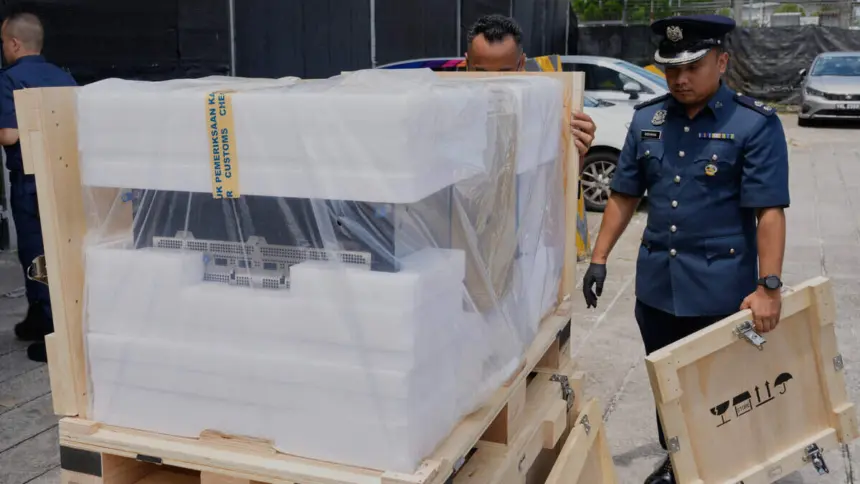
Malaysian customs officers have seized 49.5 million ringgit ($12.1 million) worth of smuggled AI chips at Kuala Lumpur International Airport, authorities announced on Wednesday. Officers uncovered 30 server units packed with restricted high-performance semiconductors during an inspection in the airport free trade zone on 15 October 2026.
Key points
- Malaysian customs intercepted 30 server units containing $12.1 million in advanced artificial intelligence semiconductors at Kuala Lumpur airport.
- The cargo arrived from an unnamed Asian country and was destined for another, disguised as basic electronic parts to evade export controls.
- Officials linked the shipment to a smuggling syndicate tied to five seizures worth over 100 million ringgit ($25 million).
- Malaysia introduced mandatory permits for moving American-origin AI silicon last year after pressure from the United States.
Inspection at the free trade zone
Customs officers discovered the consignment during a targeted inspection inside the cargo area of Kuala Lumpur International Airport. The shipment comprised 30 enterprise server units configured with high-performance silicon used to train and run machine learning models.
Investigators found that the hardware originated in an Asian country and was booked for transfer to a second Asian destination. Moving such hardware through Malaysia requires an approved strategic trade permit, which the shippers did not possess.
Aspalila Ag Tuah, the customs director at Kuala Lumpur International Airport, told reporters that the exporters tried to hide the true nature of the cargo. “The servers were falsely declared as electronic components,” Aspalila said, explaining that the shippers routed the goods through Malaysia to evade screening before dispatch to their final buyer.

Officials have questioned representatives from a local logistics firm that handled customs clearance for the freight. Investigators are reviewing transport manifests, billing records and communication logs to identify the individual brokers who arranged the route.
A syndicate skirting trade permits
The October bust is part of a broader operation against an organised smuggling network active across Southeast Asia. Customs officials believe the same syndicate coordinated an attempt in June 2026, when authorities at the same airport stopped an unpermitted consignment of AI servers worth nearly $13 million.
Aspalila said the group has been tied to at least five separate semiconductor interception cases. In total, Malaysian authorities have confiscated more than 100 million ringgit (around $25 million) in illicit hardware linked to the network.
Syndicates frequently exploit free trade zones at major regional transit hubs. Cargo moving through these zones often faces less paperwork if it does not formally enter the domestic economy, allowing smugglers to swap documentation and re-label containers before onward transit.

US export controls and Southeast Asian transit
Malaysia updated its trade regulations last year to require export and transshipment licences for advanced processors originating in the United States. The rules followed sustained diplomatic pressure from Washington, which has attempted to close enforcement gaps across Asian trade corridors.
The US government has placed tight restrictions on sales of advanced AI processors to prevent Chinese companies and state laboratories from building high-level computing clusters. In response, buyers subject to trade bans have turned to third-party brokers in intermediate nations to source hardware.
Because Malaysia possesses a large domestic electronics packaging and testing industry, hundreds of millions of dollars in electronic components pass through its air and sea ports each week. Smugglers have attempted to blend high-value AI servers into this regular commercial traffic by submitting vague cargo descriptions.
Regional crackdown on illicit semiconductor flows
Malaysia is not the only regional hub tightening surveillance on technology diversion. Authorities across Asia have stepped up inspections at ports and freight forwarders as smuggling tactics become more complex.
Taiwanese prosecutors have also opened several criminal inquiries into illicit semiconductor supply lines. Investigators in Taipei recently arrested multiple individuals, including staff from server manufacturer Supermicro and chip designer Nvidia, over allegations that they arranged unauthorised shipments of restricted AI systems to buyers in mainland China.
Malaysian customs officials stated that their investigation remains active as they track the international partners behind the seized servers. The agency plans to expand spot checks on high-value electronic consignments passing through airport free trade zones.