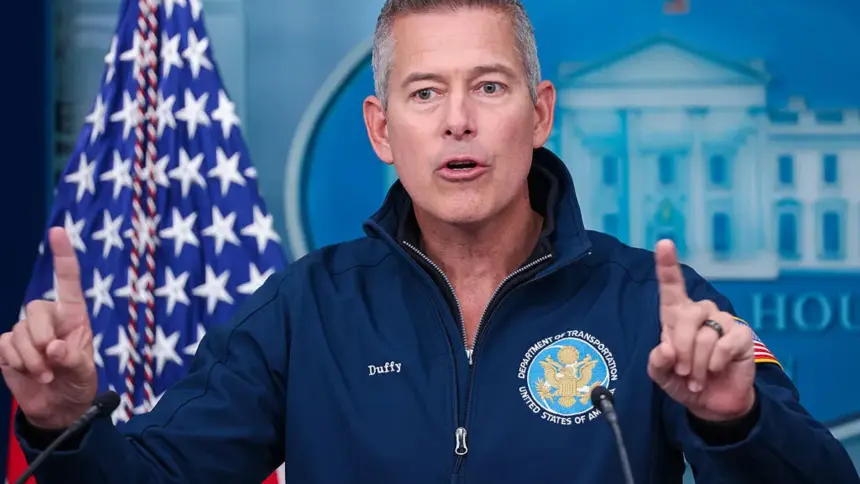
A nationwide FAA ground stop that grounded thousands of US flights on Friday stemmed from routine maintenance replacing an obsolete copper wire at a remote facility, US Transportation Secretary Sean Duffy said on Saturday. A newly installed router flooded the air traffic control network, disrupting radar feeds and pilot communications across the country.
The disruption triggered the third nationwide ground halt of the 21st century. More than 8,200 flights were cancelled on Friday evening, according to data from aviation tracking firm Cirium, and the fallout continued into Saturday with at least 3,000 additional cancellations.
Speaking at a press conference on Saturday, Duffy said technicians were replacing copper cabling with a fibre optic connection at a remote facility because the existing circuit was being discontinued. He told reporters that it was “such an old wire that it was being discontinued, meaning that line was going to get shut down”.
Duffy said the work was routine maintenance rather than part of a major modernisation initiative. Even so, the hardware swap disrupted critical air traffic control infrastructure across the country.
How router flooding halted flights
The failure began after FAA contractor L3Harris carried out the physical upgrade. Following the installation, the new router flooded other air traffic control routers with connection requests, as The Verge reported.
Duffy said the equipment generated over 1,000 connection attempts every four to five seconds. That surge flooded the network, disrupting radar feeds and communications with aircraft.

Rebecca Guy, the FAA’s acting chief technology officer, said agency engineers noticed network instability and identified two locations pinging internal systems at that high rate. Technicians disabled both sources immediately to stabilise the network, and the agency is now carrying out a root cause analysis.
Questions over contractor work and timing
Federal officials are investigating whether the incident was caused by defective hardware or human error during the installation. Duffy said the agency is working to determine whether staff from L3Harris made a configuration mistake or installed a faulty router, according to TechCrunch.
Reporters asked Duffy why engineers carried out the network upgrade at 3.00 pm on a Friday rather than at midnight on a Saturday.
Duffy replied that while switchovers at larger airports take place late at night, the agency carries out remote switchovers during the day. He said the FAA will re-evaluate when this work takes place.
Funding demands and dismissed AI rumours
Duffy used the briefing to call on Congress for additional funding to modernise air traffic control equipment. He said the FAA is building safely and quickly, but argued that lawmakers had provided only a partial payment towards the necessary work.
The outage occurred a day after the FAA announced the rollout of an artificial intelligence tool for air traffic controllers. The union representing controllers had said it was not consulted on the design of that system.
Speculation grew after Homeland Security Secretary Markwayne Mullin gave an ambiguous answer when asked earlier if AI caused the disruption, referring to the technology as SI instead.
FAA Administrator Bryan Bedford dismissed any link between the network crash and automated software, saying the agency saw “zero evidence of anything nefarious and zero evidence of anything AI-related”. Bedford said the agency is continuing work to identify the defective piece of equipment.