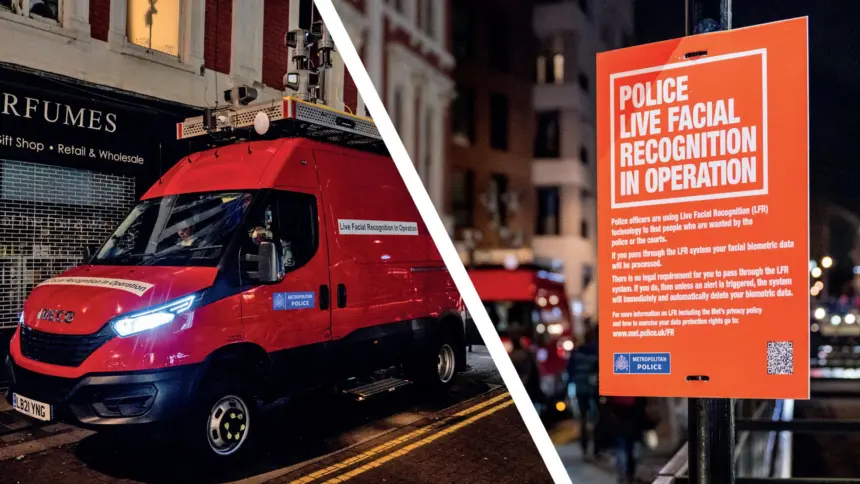
The UK government is preparing a new legislative framework to govern police use of live facial recognition, ministers announced following a public consultation. The move comes as Home Office documents reveal plans to widen camera deployments from criminal policing into civil immigration enforcement across public events and transport hubs.
Key points
- The Home Office plans legislation to establish statutory principles and parameters for police facial recognition.
- Immigration enforcement has entered the formal delivery phase for facial recognition watchlists covering civil status violations.
- The Metropolitan Police plans to introduce fixed cameras in central London after recording 3,000 arrests with mobile vans.
- Watchdogs and civil liberties groups warn that immigration deployments lack independent oversight and statutory limits.
New legal limits for police surveillance
Sarah Jones, the policing minister, said the government will put new legal parameters and principles into statute to regulate police deployments of live facial recognition. The announcement follows a 10-week public consultation on police use of biometrics launched by the Home Office in December 2025.
British forces have tested the technology since 2015. Jones, the MP for Croydon West, told the BBC that while the public supports crime fighting, people expect safeguards against mission creep. “We have to use it proportionately. We have to use it in an intelligence-led way,” Jones said, adding that cameras should not track minor issues like unpaid parking fines.
Live facial recognition cameras scan faces in crowded spaces and compare them against watchlists of wanted suspects and missing persons. Police delete biometric data from non-matching faces immediately, and human officers must check and confirm any algorithmic match before taking action.

London’s Metropolitan Police has deployed the cameras from mobile vans, attributing more than 3,000 arrests to the system over the past two years. The force now intends to install fixed camera systems in high-footfall areas of the capital, including parts of Soho and the West End.
Immigration enforcement expands camera deployment
While the policing minister promised statutory boundaries, Home Office records reveal an operational expansion into civil border control. Guidance published on 8 October, alongside an October data protection impact assessment, confirmed that immigration enforcement has moved its live facial recognition project into formal delivery.
The programme marks a significant shift, using live cameras to track people for non-criminal immigration offences. Officials plan to place individuals on watchlists for overstaying visas or entering without leave, alongside those subject to deportation orders or criminal warrants.
The Home Office intends to deploy cameras proactively at transport hubs and specific events expected to draw large crowds. Internal policy files list locations with heightened community sensitivity as higher-risk deployments, though the department declined to give details on specific venues or geographical areas.

The operational shift follows a political decision by Shabana Mahmood, the home secretary, to double the immigration enforcement budget and increase staff numbers by 60 per cent. The Home Office argued in policy documents that scanning public crowds will cause less community disruption than conducting enforcement visits at residential addresses or workplaces.
Earlier trials and accuracy concerns
The national expansion builds on three field trials conducted between November 2025 and February 2026 at Holyhead port in north Wales. Those trials focused on passengers travelling from Ireland through the common travel area who breached deportation orders or faced outstanding immigration warrants.
Home Office guidelines state that children under 18 will not appear on immigration watchlists. However, civil rights groups pointed to earlier departmental deployments of AI age-estimation software, which continued operating after officials learned it had misidentified child migrants as adults.
Campaigners have also highlighted studies showing algorithmic bias and higher rates of false matches for people of colour in biometric surveillance systems. Griff Ferris of the Joint Council for the Welfare of Immigrants warned that expanding public camera surveillance threatens migrant communities already subjected to aggressive enforcement operations.
Gaps in regulatory oversight
Civil liberties groups criticised the government for delaying national rules while camera networks expanded across train stations, Underground stops and retail stores. Jasleen Chaggar, senior legal and policy officer at Big Brother Watch, told the BBC that the technology serves as “an indiscriminate tool” that compromises the presumption of innocence.
Sarah Lasoye of the Open Rights Group said public bodies are expanding biometric monitoring without democratic consent, exploiting an absence of national legislation governing public-sector AI tools.
Regulatory oversight has also come into dispute. While Home Office policy documents stated that immigration deployments fall under oversight by the Information Commissioner’s Office and the biometrics and surveillance camera commissioner, the watchdog disputed that account.
William Webster, the biometrics and surveillance camera commissioner, told Liberty Investigates that the Home Office never consulted him on the policy. Webster said immigration enforcement lies outside his statutory remit, warning that expanding camera systems across public services creates urgent questions for regulatory authorities.
What happens next
The Home Office confirmed it is considering further operational trials for immigration enforcement as it explores broader uses for the technology. Ministers have reiterated their intention to bring forward the policing framework, but have so far refrained from committing to specific statutory safeguards.