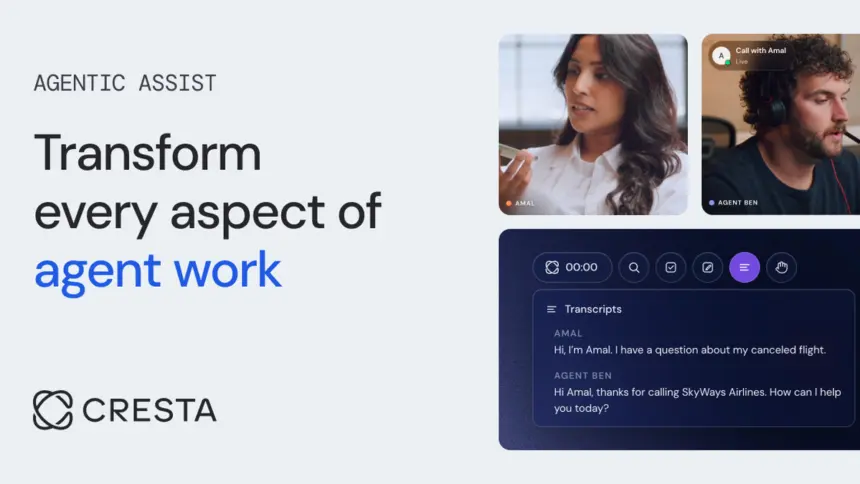
As Salesforce acquires Cresta under a definitive agreement announced on 2 November 2026, the software vendor plans to bring autonomous telephone agents, live staff guidance and call analytics directly into its Service Cloud suite. The transaction is scheduled to complete in the first quarter of Salesforce’s fiscal 2028, subject to standard closing conditions and regulatory approvals.
Key points
- Salesforce agreed a definitive takeover of Cresta to build a voice-led operating system within its Service Cloud and Agentforce suites.
- The deal incorporates autonomous voice bots, live assistant prompts for contact-centre staff, and automated conversation quality scoring.
- Current enterprise clients including Marriott, Comcast and Alaska Airlines will retain support across their existing telephone infrastructure.
- The transaction is scheduled to complete in the first quarter of Salesforce’s fiscal 2028, pending regulatory clearance.
The takeover centres on contact-centre voice operations, an area enterprise software vendors have struggled to automate without frustrating callers. While text chatbots have become standard on websites, telephone support remains complicated for automation systems because callers talk over prompts, change topics midway through sentences, and expect rapid answers.
Salesforce executive Kishan Chetan, who leads the company’s Service Cloud and Agentforce units, described telephone conversations as the most demanding and significant channel in customer support. Under the agreement, Salesforce announced that Cresta’s software will form a voice-led operating system embedded into Service Cloud. The acquisition expands Salesforce’s broader enterprise automation push, which has seen the company deploy infrastructure across large public bodies and commercial accounts, including ongoing work on the HMRC Salesforce contract in the public sector.
Voice agents and workflow execution
Cresta’s system is built around autonomous agents capable of resolving complex spoken calls without human intervention. The software handles interruptions and speech overlaps, letting callers clarify details or change direction mid-sentence without resetting the conversation flow. Large enterprise brands including Marriott, Comcast and Alaska Airlines already run the platform across their telephone operations.

Handling a voice call requires more than generating natural speech. A customer service agent must look up records, cancel bookings, adjust billing schedules, and authenticate account holders while the call is taking place. According to Cresta’s AI Agent documentation, the platform relies on shared memory architecture to maintain conversational context during handoffs between automated systems and human agents.
To carry out back-office actions, the agents link to external customer relationship management databases, payment gateways, and scheduling platforms. The architecture uses secure function calling alongside the Model Context Protocol (MCP) to access tools across enterprise networks. By linking spoken requests directly to business systems, the system carries out the underlying service workflow rather than simply providing conversational answers.
Deciding which customer issues to automate is handled through Cresta’s automation planning software. The tool audits historical call records, grouping customer interactions by call volume, issue complexity, and historical resolution rates. Tasks with clear boundaries and high frequency are flagged for automation, while sensitive or unpredictable queries remain routed to human staff. The planning system also studies recordings of high-performing human representatives, identifying phrases, pacing, and diagnostic questions that lead to successful outcomes, then incorporates those traits into automated voice agents.
Live support for human representatives
Alongside autonomous agents, the transaction brings Salesforce tools designed for human contact-centre workers. Cresta’s Agentic Assist monitors live customer phone calls to provide real-time suggestions, reminders, and procedural checklists to the representative handling the case.

The assist software evaluates both audio dialogue and on-screen records. If a caller asks about a specific contractual clause or refund condition, the software identifies the topic and displays verified, source-backed answers directly on the representative’s screen. Once the call ends, the software generates structured call summaries, logging the customer’s intent, the actions taken, and outstanding follow-ups. Automating these notes reduces administrative after-call work, which often consumes several minutes of an agent’s time after every telephone interaction.
This structure allows organisations to run a blended operating model. A single customer enquiry may start with an automated voice agent, transfer to a human specialist if the issue escalates, and continue with the human agent receiving real-time suggestions from the assistant. Context gathered during the automated phase carries over, preventing the customer from repeating details.
Conversation intelligence and coaching
Quality assurance represents another major piece of the Cresta platform. Contact centres traditionally evaluate quality by having managers listen to a small sample of recorded calls each week, leaving the vast majority of interactions unreviewed.
Cresta’s Conversation Intelligence software automates this oversight by scoring every customer interaction across both human and automated agents. The software tracks dialogue topics, customer sentiment, compliance statements, and operational outcomes. The resulting data feeds into automated coaching plans for human staff.
To support staff development, the system generates training simulations derived from real customer conversations. Representatives can practise dealing with difficult scenarios or new product lines against synthetic callers that replicate actual customer behaviours. The same analytical engine tracks automated agent performance, highlighting instances where synthetic agents failed to understand regional accents or mishandled complicated requests.
Deployment controls and enterprise integration
Deploying generative models in high-volume contact centres presents operational risks, including incorrect statements, data leaks, and compliance failures. Cresta addresses these risks by combining language models with deterministic logic. While natural language models interpret spoken words and formulate responses, deterministic software tracks the exact state of the call and enforces obligatory legal disclaimers, identity checks, and workflow steps.
The software includes real-time monitoring and an operations centre where supervisors can oversee active sessions, inject guidance, or take manual control of a call if an agent encounters difficulties. Before any update goes live, contact-centre managers can run the modified agent against thousands of synthetic customer personas created from historical call data. Production errors are automatically converted into regression tests, and teams can run controlled A/B split tests on live telephone traffic to verify performance before full rollout.
Salesforce confirmed that following the acquisition, Cresta will maintain compatibility with third-party contact-centre suites and telephony hardware. Cresta chief executive Ping Wu said combining the companies will embed real-time conversation intelligence and agentic workflows directly into Salesforce’s broader service portfolio.
The acquisition represents one of several large-scale consolidations reshaping enterprise technology infrastructure, following transactions such as the Marvell acquires Lumentum agreement. For Salesforce, the Cresta acquisition provides dedicated voice infrastructure to support its Agentforce product line, aiming to turn voice support from a costly operational bottleneck into an automated, data-driven workflow.