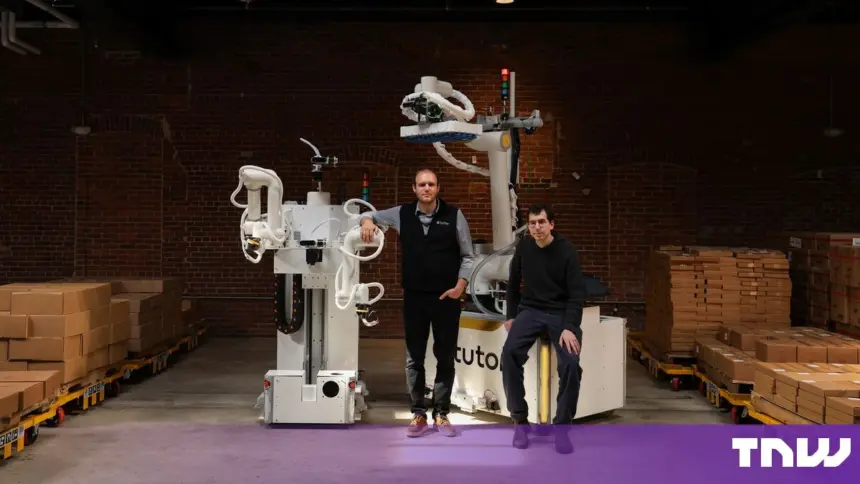
Tutor Intelligence has secured $75 million in a Tutor Intelligence Series B funding round led by Andreessen Horowitz to expand its fleet of pay-by-the-hour industrial robots, the company announced on Monday. The Watertown, Massachusetts startup uses remote human operators to train and guide warehouse machines, bringing its total capital raised to date to $117 million.
Key points
- Andreessen Horowitz led the $75 million investment, with backing from previous investors Union Square Ventures and Neo.
- Tutor charges warehouses by the hour or per pick rather than selling hardware, removing upfront capital costs for customers.
- The company expects to place more than 1,000 American-built robots under contract across logistics networks by the end of 2027.
- Remote human supervisors guide machines through complex tasks, generating operational data used to train proprietary foundation models.
Pay-by-the-hour robotics on factory floors
Tutor Intelligence does not sell its hardware outright. Instead, the Massachusetts-based company rents the labour of its machines, charging clients either by the hour or on a per-pick basis. Customers do not sign long-term hardware contracts or pay initial setup charges.
Under this arrangement, Tutor assumes responsibility for deployment, maintenance, and ongoing software delivery. If a unit breaks down or struggles with an unfamiliar item, the financial risk sits with the supplier rather than the warehouse operator. Tutor sends updates and model iterations over the air to keep the units running.
The business model removes the heavy balance-sheet commitment that often stops distribution centres from testing automation. Facilities can introduce mechanical labour as an operational expense alongside existing payroll, testing machines directly on active assembly lines.

Tutor builds two primary robot workers, named Sonny and Cassie. Both run proprietary models developed in-house. The machines currently handle goods such as breakfast cereals, snacks, sweets, cosmetics, household items and toys across some of the largest distribution networks in the United States.
How mixed-autonomy training works
Tutor emerged from the Computer Science and Artificial Intelligence Laboratory at the Massachusetts Institute of Technology. Its technical strategy relies on mixed autonomy, combining computer vision models with human supervision to bypass common automation bottlenecks.
When an on-site robot encounters an unfamiliar product shape, awkward packaging, or an unexpected jam, internet-connected remote human workers step in. Tutor refers to these off-site operators as tutors. These handlers guide the arms through the manoeuvre from miles away, ensuring factory conveyor belts do not stall.
Every manual correction and completed task feeds operational data back into Tutor’s engineering pipeline. The startup uses these real-world records to train its robot foundation models, gradually decreasing the need for human intervention over time. The approach mirrors software methods seen in process-learning AI coworkers, applying live operational feedback directly into machine weights.

Raghu Raghuram, a general partner at Andreessen Horowitz and former chief executive of VMware, pointed to this deployment-first methodology as the primary driver behind the investment. Raghuram argued that practical deployment data provides the fastest route to general-purpose robotic autonomy.
“Continual learning across an expanding range of deployments is the path from specialized capabilities to general-purpose robotics,” Raghuram said.
The race for industrial automation capital
The fresh round brings Tutor’s total private funding to $117 million, according to the company’s formal funding statement. Union Square Ventures, which led Tutor’s Series A round, and seed backer Neo also joined the round. The startup declined to disclose its current valuation or revenue metrics.
Venture investors have stepped up commitments to physical automation throughout recent quarters as consumer goods manufacturers face persistent labour constraints in distribution hubs. Several competing robotics specialists have closed substantial financing rounds in recent weeks.
Formic recently raised $50 million to expand its own automated factory labour services, while Eka Robotics secured $150 million to refine mechanical grip mechanisms. Training infrastructure providers have also benefited, with Maxinsights collecting $30 million to generate training datasets for robotic visual systems.
Tutor claims its footprint has expanded swiftly despite broader economic caution. The company reported that its machines operate in almost four times as many facilities as they did twelve months ago. Nearly a third of the sites that installed Tutor hardware over the past year were existing customers expanding their initial orders.
“We can hardly build robots fast enough,” said Josh Gruenstein, co-founder and chief executive of Tutor Intelligence.
What happens next for US manufacturing
Tutor will direct the $75 million toward training its central foundation models and expanding physical production lines. The company manufactures its hardware in the United States, positioning domestic assembly as a central operational target.
Tutor aims to have more than 1,000 robots active under contract by the end of 2027. While the business has not disclosed the exact count of Sonny and Cassie units currently working in the field, meeting that milestone will require scaling hardware manufacturing alongside remote supervisory staff.
The company will also continue testing its systems across more delicate consumer categories, gathering edge-case data on packaging styles that continue to confound traditional rigid industrial automation.