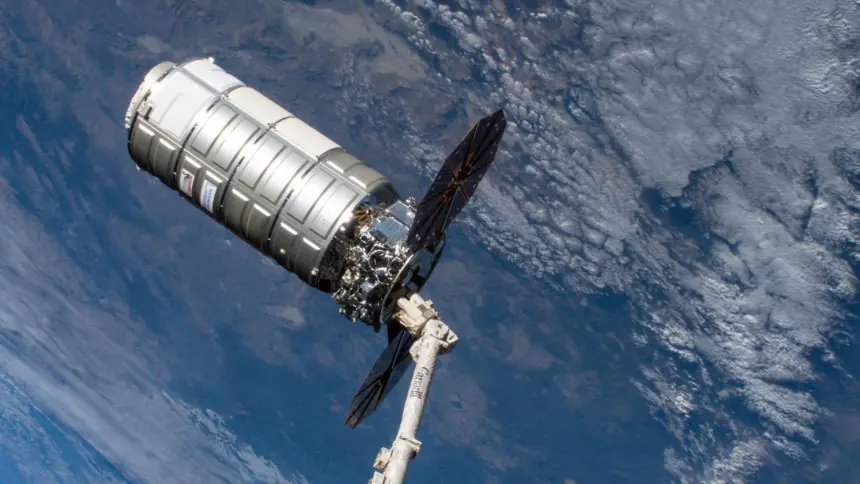
Google and NASA are developing an experimental robotic medical assistant designed to help astronauts manage health emergencies and logistical duties on future deep-space expeditions. The prototype machine is built to retrieve clinical instruments, support ultrasound scans, and move supplies during long-duration flights to destinations such as Mars, where direct radio communication with flight surgeons on Earth faces severe time lags.
Key points
- Google Cloud, NASA’s Human Research Program, the Johnson Space Center robotics team, and the Jet Propulsion Laboratory are co-developing the system.
- The autonomous helper assists human crew officers rather than replacing them, fetching equipment such as ultrasound scanners during medical emergencies.
- Round-trip signal delays between Earth and Mars can reach 44 minutes, making real-time telemedicine impossible during urgent diagnoses.
- In initial laboratory trials, the robot achieved an 85 percent success rate when locating and moving a medical supply pack.
Handling medical crises across deep space
During a flight to Mars, astronauts will travel millions of miles from standard clinical infrastructure. If a crew member falls ill, calling mission control in Houston will not yield an instant answer.
That communication lag rules out interactive telemedicine during acute health events. To address the gap, Google Cloud is collaborating with NASA’s Human Research Program, robotics engineers at Johnson Space Center in Houston, and the Jet Propulsion Laboratory in California to test an automated helper capable of acting inside the spacecraft cabin.
The system builds on the Crew Medical Officer Digital Assistant, an artificial intelligence software project that Google and NASA have evaluated since 2025. While that earlier software focuses on symptom assessment and reference data, the new initiative pairs algorithmic reasoning with mechanical arms and mobile chassis to manipulate physical objects in the habitat.
How the robot assists an astronaut crew
The robot is not designed to operate autonomously as a surgeon or physician. Flight protocols place all clinical diagnosis and treatment choices under the authority of the human crew medical officer. Instead, the machine handles manual preparations, fetching instruments and clearing work surfaces so the astronaut doctor can focus on patient care.
In one scenario tested by the engineering team, an astronaut experiences acute back pain that may stem from a renal stone. The crew officer instructs the robot to locate an ultrasound probe, power it on, and bring it to the examination bench. The machine positions the probe stand and sets up imaging feeds while the human officer examines the scans.
Jim Kelly, Google’s public sector vice president, said the project aims to build hardware that responds to ordinary voice commands during demanding operations. “The ultimate goal is to build a robotic system that can execute a variety of tasks via simple voice instructions, under the astronauts’ direct supervision and command,” Kelly said.
Voice-directed physical handling prevents the crew officer from breaking sterile protocol or stepping away from a distressed patient to search storage lockers.
Dual duties for lean crew manifests
Deep-space exploration vehicles will operate with minimal crew sizes, likely between four and six people. Space agencies cannot afford to dedicate launch weight and cabin volume to a machine that sits idle between medical emergencies. Because clinical crises are rare, engineers designed the hardware to conduct ordinary maintenance and inventory management.
When clinical support is not needed, the robot moves cargo containers, tracks stored components, organises hand tools, and inspects mechanical compartments. The machine’s gripping mechanisms and software allow it to change tasks as soon as an alert sounds.
“To maximize its utility for a lean crew, the robotic system is designed as a versatile ‘payload’ handler capable of managing cargo, logistics, and equipment,” Kelly said.
Shifting labour-intensive cargo hauling to automated machinery protects human energy for scientific experiments and mission flight checks. It also mirrors broader aerospace efforts to run automated machine learning software locally inside spacecraft habitats, similar to how Google tested its orbital AI inference using space TPUs on low-Earth orbit satellites.
Simulation tests and navigation hurdles
Moving through a spacecraft cabin poses unusual spatial hurdles. Lockers line every bulkhead, equipment tethers drift across paths, and cabins lack the predictable layouts of terrestrial hospitals. To help the robot map corridors and pinpoint gear, Google is adapting optical navigation algorithms developed by engineers at NASA’s Jet Propulsion Laboratory.
Before building physical prototypes for all operational profiles, engineers modelled the machine’s limbs and grasping dynamics inside DeepMind’s MuJoCo physics engine. The simulation platform tested how robotic joints handle delicate instruments and bulky payload bags without snagging cables or dropping items.
Laboratory trials conducted on Earth have produced initial baseline figures. According to Kelly, the prototype achieved an 85 percent success rate when locating and moving a medical storage bag across a mock habitat. While the result proves basic visual identification and gripping functions, it also highlights that roughly one out of seven retrieval attempts failed to complete as intended.
Engineers must raise that reliability rate considerably before deploying such hardware on a crewed vehicle. An uncompleted retrieval during a cardiac event or toxic exposure could compromise patient survival.
What happens next
Google classifies the current project as a proof of concept. The joint team has completed controlled bench demonstrations, but neither party has built an integrated, flight-qualified chassis certified for launch vibrations or microgravity operations.
NASA has declined to provide a formal deployment timetable for the machine, saying only that it continues to study automated support systems across several research tracks for future Mars exploration architectures. Engineers at Johnson Space Center and Google Cloud plan further trials focusing on microgravity motion control, tactile sensor feedback, and onboard voice recognition that operates without cloud data connections.