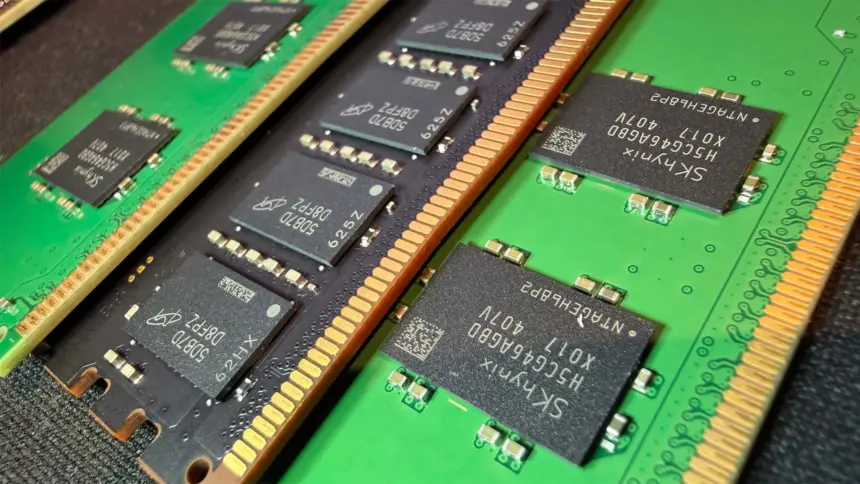
A US federal judge in California has refused to dismiss an antitrust class-action lawsuit accusing Samsung, SK Hynix and Micron of DRAM price fixing. The ruling on 14 November clears the way for claims that the three chipmakers illegally co-ordinated cuts to conventional computer memory supply to drive up prices.
Judge Noël Wise of the US District Court for the Northern District of California denied in full the manufacturers’ joint motion to throw out the case, legal news site LitNews reported. Judge Wise decided that the filing made a credible case for an unlawful conspiracy under Section 1 of the Sherman Act, allowing the litigation to move forward.
Seventeen consumers and small businesses from five US states brought the action on 25 June 2026, according to the public court docket. The plaintiffs claim that Samsung, SK Hynix and Micron exercised their joint dominance to engineer an artificial shortage of standard computer memory chips. Together, the three manufacturers accounted for more than 91 percent of worldwide dynamic random-access memory (DRAM) revenue in the third quarter of 2025.
The chipmakers contended that the dispute was merely a retread of DRAM II, an earlier antitrust action over 2016 to 2018 supply restrictions that the US Ninth Circuit Court of Appeals threw out in 2022. Judge Wise rejected that argument, writing: “The Court finds that it is not.”
At a hearing, the defendants cited legal precedent suggesting competitors in concentrated industries naturally watch one another closely. Judge Wise dismissed that comparison. She wrote that “their contentions are more akin to hawks flying in formation”, which competitors ordinarily do not do.
Parallel cuts and soaring prices
According to the complaint, the three companies began curbing production of conventional DRAM in late 2022. They redirected silicon wafer capacity toward High Bandwidth Memory (HBM) starting in 2023 to supply accelerators used in artificial intelligence models.

Standard DDR5 memory chips go into personal computers, phones and servers, whereas HBM packages multiple memory dies together into dense vertical stacks. Fabricating HBM consumes three to four times more silicon wafer area per gigabyte than standard DDR5, tech site Wccftech reported from the lawsuit. That capacity transfer left far fewer production wafers for commodity PC and server memory.
The resulting squeeze drove conventional DRAM prices up by 171.8 percent in the year leading to the third quarter of 2025. Over an 18-month span, prices climbed 697 percent. Despite these record prices, none of the three manufacturers expanded or announced plans to expand commodity DRAM manufacturing capacity.
The defendants argued that differences in timing demonstrated their choices were independent rather than co-ordinated. SK Hynix and Micron announced production cuts three weeks apart in late 2022, while Samsung followed four and a half months later on 7 April 2023. Judge Wise ruled that Samsung’s lag was not long enough to undermine the claim of parallel conduct on a motion to dismiss.
Conduct beyond ordinary market behaviour
Under US antitrust law, plaintiffs without direct proof of secret pacts must demonstrate additional evidence, known as plus factors, pointing to advance agreement rather than independent parallel action. Actions against self-interest must be risky enough that no rational firm would take them without assurances.
Judge Wise concluded that while shifting wafer capacity to HBM on its own might not prove collusion, several irreversible steps taken alongside it crossed that legal threshold. All three companies entered long-term contracts locking in their HBM output, but Samsung and SK Hynix refused to sign long-term supply agreements with major conventional DRAM buyers.
Samsung and Micron also delayed or halted construction on new memory fabrication plants. Citing Ninth Circuit precedent on industrial refinery capacity, Judge Wise stated that decisions to build or freeze manufacturing capacity cannot be quickly reversed.
All three manufacturers also wound down production of DDR4 memory in the same quarter of 2025, leading older, slower DDR4 chips to cost more per gigabyte than newer DDR5. On 3 December 2025, Micron announced it would shut down Crucial, its 30-year-old consumer memory brand. In January 2026, all three introduced near-identical customer-vetting procedures. Judge Wise noted these vetting rules arrived after the AI boom was already under way.
Arguments the court set aside
Judge Wise declined to give weight to several other claims put forward by the plaintiffs. Remarks by executives to investors referencing disciplined supply were too similar to statements previously excused in the DRAM II case.
She also set aside allegations concerning informal executive gatherings at trade conferences, noting appeals court precedent requires evidence of what was discussed. The judge treated the oligopolistic structure of the DRAM market as a neutral factor rather than proof of collusion.
The court did, however, allow the plaintiffs to reference past cartel activity. Samsung, Hynix and Micron participated in a DRAM price-fixing conspiracy between 1998 and 2002. Samsung paid a $300 million criminal fine, Hynix paid $185 million, and Micron received immunity as a whistleblower. Judge Wise held that this history remained relevant.
Next steps in the lawsuit
Law firm Bathaee Dunne represents the plaintiffs. For the defence, O’Melveny & Myers acts for Samsung, Cleary Gottlieb Steen & Hamilton represents SK Hynix, and Gibson Dunn & Crutcher appears for Micron.
The ruling does not decide whether the companies broke the law; the allegations are accepted as true only for deciding the motion to dismiss. Judge Wise ordered Samsung, SK Hynix and Micron to file their formal answers to the complaint by 7 December 2026. The initial case management conference is scheduled for 12 January 2027 at 9:00 a.m.