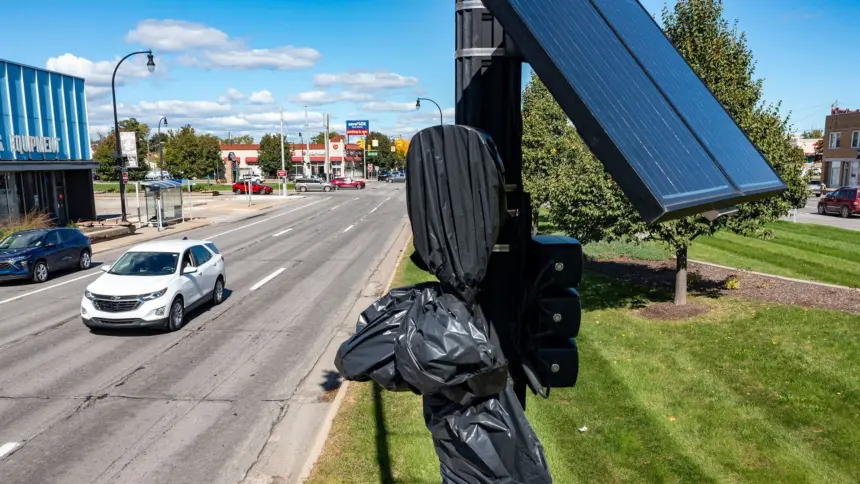
Municipal officials in Plymouth, Minnesota, have physically cut power to Flock safety cameras across the city after the surveillance company failed to respond to a contract cancellation. Police officers disconnected the automated licence plate readers by hand in late September 2026 following a unanimous city council vote to terminate the service over privacy controversies.
Key points
- Plymouth City Council voted unanimously on 22 September 2026 to end its contract with surveillance vendor Flock Safety.
- Police Chief Eric Fadden ordered officers to disconnect camera power cables after the company failed to reply to formal cancellation notices.
- Neighbouring Dayton, Minnesota, also paused its deployment after the firm attempted an unauthorised hardware replacement.
- Critics have raised alarm over algorithmic vehicle profiling, police misuse and erroneous stops generated by automated camera networks.
How Plymouth disconnected the camera network
The dispute in Plymouth began on 22 September 2026, when the city council voted unanimously to discontinue the municipality’s contract with Flock Safety. The following morning, local authorities suspended all municipal user accounts on the vendor’s software portal and sent formal notification of the termination by post and email. The letters requested prompt removal of the automated licence plate readers mounted on public roadways.
When more than a week passed with no formal response from Flock’s corporate office or legal department, the city decided not to wait. Police Chief Eric Fadden instructed department staff to visit camera locations across Plymouth and pull the power cords directly from the units. Fadden told automotive publication The Drive that officers disconnected the hardware to ensure the devices could no longer record vehicle movements or store number plates.
Fadden noted that while municipal staff had spoken briefly with a regional sales representative, the company’s central management had not acknowledged the formal termination. Cutting the electrical supply ensured that even if the hardware remained affixed to utility poles, data collection inside city limits ceased immediately.

Disputes expand to neighbouring towns
Plymouth is not the only jurisdiction in Minnesota pushing back against the vendor’s hardware presence. Ten miles to the north, the city of Dayton has also frozen its local camera programme. Local administrators in Dayton paused operations and deactivated two installed units while reviewing surveillance policies.
Despite instructions from Dayton police telling Flock Safety not to carry out further maintenance or equipment swaps, the company sent technicians to replace the deactivated units anyway. Police discovered that a work order had moved forward without municipal approval, deepening friction between local government leaders and the private surveillance firm.
Industry observers note that removing camera hardware incurs labour and logistics costs for private vendors. Keeping installed units on roadside poles, even during contract disputes, preserves physical network footprint at minimal ongoing expense to the provider. For local councils seeking to end automated vehicle tracking, however, lingering hardware creates legal ambiguity and public distrust.
What the vehicle tracking system records
Flock Safety operates more than 300,000 cameras across the United States, selling access to police departments, local councils, neighbourhood associations and private businesses. While marketed primarily as automated licence plate readers, the company’s devices use computer vision models that capture substantially more detail than standard number plate data.

The underlying software analyses camera feeds to identify vehicle colour, make, model and body style. The system also categorises visual alterations such as roof racks, bumper stickers, dents, custom wheels and missing plates. Officers using the software can run broad searches across regional networks, querying for specific car attributes rather than a confirmed registration number.
The vendor’s central databases pool detections from thousands of roadside units, allowing law enforcement agencies to track vehicle journeys across municipal and state borders. In some deployments, the software applies machine learning routines to flag travel histories as suspicious based on historical movement patterns, triggering real-time alerts on police cruiser terminals.
Erroneous stops and civil liberties concerns
The decision by Minnesota municipalities to abandon the hardware follows a series of public controversies involving algorithmic errors and system abuse. In one incident, police in Minnesota subjected a car reviewer to an armed traffic stop because a clerical error made in California erroneously linked the vehicle’s registration to a felony warrant.
In other states, civil rights groups have documented instances where officers faced disciplinary action or criminal charges for accessing vehicle tracking databases for personal surveillance. Because automated systems log movements indiscriminately, privacy advocates argue that the technology amounts to mass surveillance without judicial warrants.
Concerns over algorithmic policing mirror broader difficulties facing visual artificial intelligence across public and commercial settings. In retail environments, automated facial recognition scanners deployed to detect suspected shoplifters have generated false matches, barring innocent shoppers from high street stores without clear routes of appeal. Campaign groups such as Big Brother Watch have warned that algorithmic screening tools often reverse the presumption of innocence, placing bureaucratic burdens on citizens to prove their identity after automated misidentifications.
The future of municipal surveillance agreements
The physical disconnection of cameras in Plymouth highlights growing friction between local authorities and private surveillance contractors. While vendors promote automated monitoring as a cost-effective way to deter property crime and locate stolen vehicles, city councils face increasing pressure from constituents over continuous location tracking.
Several cities across the United States are introducing strict procurement bylaws that require public hearings, council approval and independent privacy audits before police departments can install automated tracking networks. Contracts that permit vendors to retain vehicle data or share footage across proprietary commercial networks are facing particular scrutiny.
In Plymouth, the disconnected hardware remains mounted on roadside poles pending resolution of the contract termination. City officials have maintained that the devices will remain without power until the vendor dispatches crews to dismantle and retrieve the physical equipment.