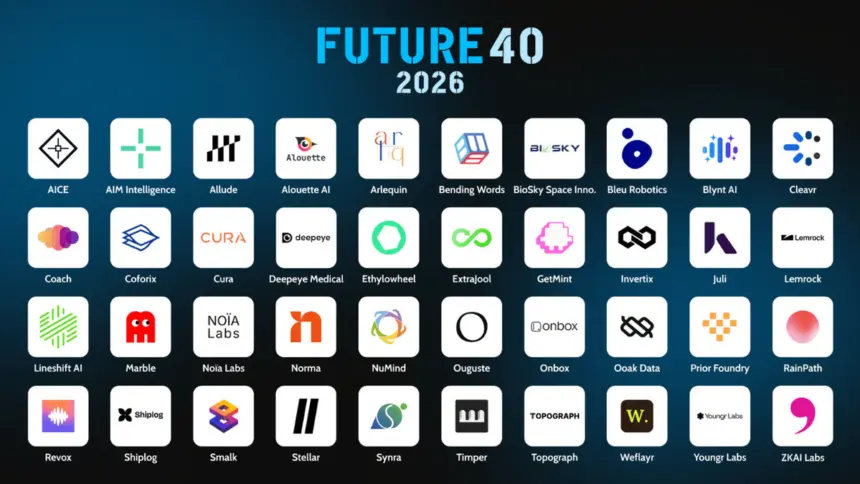
Startups linked to Paris technology campus Station F raised a record €2 billion in 2026, up from more than €1.5 billion last year, as the organisation unveiled its annual Station F Future 40 index highlighting forty of its most promising early-stage companies.
Key points
- Companies across the wider Station F network secured €2 billion in funding in 2026, lifted by nine-figure rounds from alumni Multiverse Computing and Alan.
- The eighth edition of the Future 40 index features startups that have raised a combined €110 million, with 31 teams still at pre-seed or seed stage.
- Physical AI, robotics and sovereign infrastructure dominate the cohort, alongside founders returning from Silicon Valley accelerators to build in Europe.
- Five startups on the list remain entirely bootstrapped, using autonomous software tools to generate revenue without venture capital backing.
Big rounds drive a record funding total
The €2 billion total marks the largest annual fundraising figure in the history of Station F, which French telecommunications billionaire Xavier Niel opened in 2017. The 50,000-square-metre site in central Paris supports more than 1,000 startups each year across 40 dedicated programmes, hosting founders from 60 nationalities.
A substantial portion of this year’s capital flowed into mature businesses that began life on the campus. Quantum software developer Multiverse Computing closed a €500 million round, while digital health insurance company Alan secured €480 million. Across all eight editions since 2019, companies selected for the Future 40 have raised a combined €1.2 billion.
The campus has also served as a launchpad for broader European investment rounds, such as when AI career agent startup Roleo raises funding to support regional expansion. Past cohort members have exited to major industry buyers, including creative workspace startup Pimento, which French foundational model lab Mistral acquired earlier this year, and tax automation business Flowie, bought by Sovos.

What defines the 2026 Future 40 cohort
The 40 companies chosen for the 2026 index represent roughly four per cent of the businesses active on the campus this year. Together, the cohort has raised €110 million in funding to date. Thirty-one companies are at pre-seed or seed stage, two have reached Series A, and five have taken no outside capital at all.
Decision-intelligence platform Arlequin AI raised the largest single round among the group, securing €28 million in September. Other notable totals include $10 million for CURA, which builds electrochemical carbon-capture hardware for cement production, €8 million for automated cash-collection agent Cleavr, and €7 million for agentic commerce developer Lemrock.
Fourteen of the selected businesses emerged from F/AI, the campus programme dedicated to artificial intelligence. Other teams arrived through university and corporate schemes organised with CentraleSupélec, HEC, Microsoft, Entrepreneur First and TotalEnergies.
Physical AI and technical pedigree take the lead
Software models connected directly to factory equipment, maritime drones and industrial machinery form a core theme of this year’s list. Station F identified physical AI and sovereign technologies as areas of heavy concentration among European technical founders.

Selected hardware and robotics companies include Bleu Robotics, which trains models for humanoid factory machines, and Allude, a team developing operational software for autonomous agents and robotics on manufacturing floors. In defence and maritime infrastructure, AICE is building swarms of low-cost subsea drones to protect naval fleets and offshore energy installations.
Academic and technical credentials among founders have risen sharply across the campus. In the 2026 cohort, 47 per cent of founding teams include at least one person holding a PhD, while 75 per cent are repeat entrepreneurs. Specialised healthcare ventures are also prominent, such as Coforix, which prepares hospital clinical data for medical models, and satellite grid monitoring platform BioSky.
Station F investor Camille Aubery said the campus focuses its selection on genuine industrial disruption rather than short-term pitch polish. “What we’re really trying to assess is a startup’s potential impact on its industry, the importance of its innovation, and whether the founders are the right people to build that business,” Aubery said.
Why founders are bootstrapping and leaving Silicon Valley
Five companies on the list have avoided venture investment entirely, relying on automated workflows to stay lean. Automated sales agent startup Revox booked 250 prospective customer calls in a single month using software agents rather than hiring business development staff. Legal due diligence provider Oguste reached €400,000 in annual recurring revenue in less than twelve months without outside cash.
Aubery noted that while early-stage venture funding is tighter than during the market peaks of 2021 and 2022, modern AI systems allow very small teams to hit meaningful milestones early. Two of the five bootstrapped companies are now preparing institutional funding rounds, while three plan to remain self-funded.
The cohort also highlights a migration pattern between California and Paris. Six of the companies featured in the 2026 index went through the Y Combinator accelerator programme in the United States and chose to return to France to base their core engineering operations.
Aubery said founders recognise they can tap American capital networks during accelerator batches while benefiting from lower engineering overheads in France. “It’s cheaper to build here, and you can create a global company without necessarily being based in the US,” she said.
Corporate partnerships and the next steps
Access to institutional customers remains a key commercial route for campus residents. Station F runs structured sector programmes with pharmaceutical giant Sanofi, software group Doctolib, hospital network AP-HP and energy producer TotalEnergies. TotalEnergies acquires up to four startups a year from the campus as part of its corporate technology strategy.
The 40 selected companies will present their technologies to international venture investors during an online demo day on 4 November, where investors can request direct introductions to founders from both the current group and past cohorts.